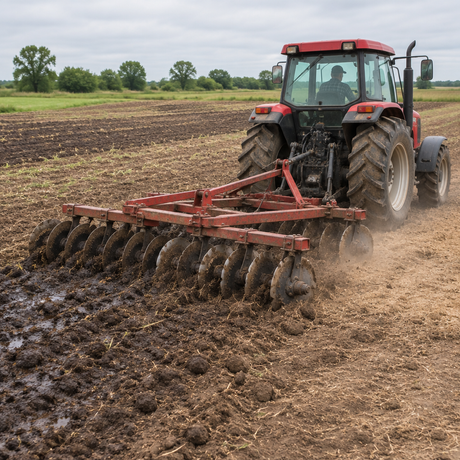
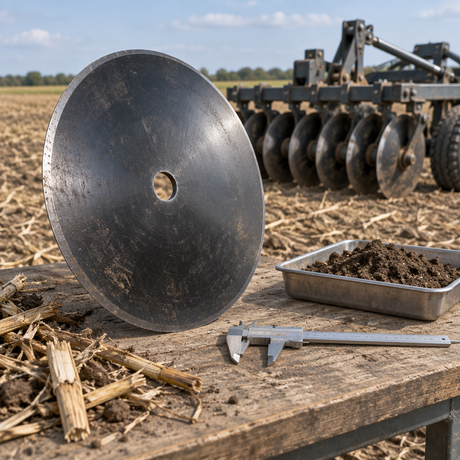
Soil moisture changes disc harrow timing because it changes how soil cuts, mixes, crumbles and carries traffic: soil that is too wet can smear, form clods and leave compaction below the disking depth, while workable moisture supports more uniform residue incorporation and seedbed preparation.
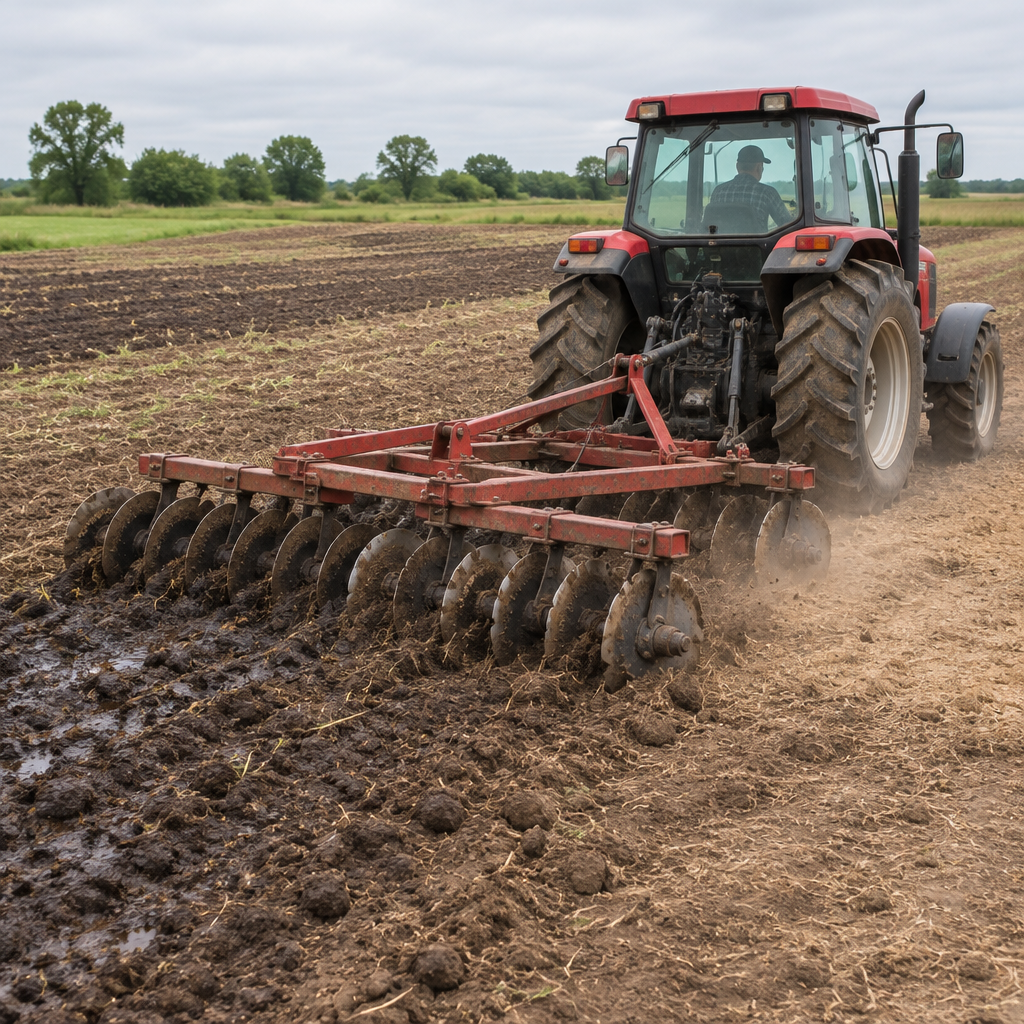
Why wet soil changes the timing decision
Wet soil is not just a traction problem; it can turn a disc harrow pass into uneven mixing, clod formation and subsurface compaction that may require more corrective tillage later.
University of Nebraska–Lincoln CropWatch explains that disking wet soils can cause non-uniform incorporation, clods and a compacted layer below the disking depth; review the CropWatch disk tillage guidance when setting local timing rules.
The timing decision also changes by season: fall disking may save spring field time, but it can raise erosion risk; spring disking fits better where soils are adequately drained and lighter textured.
A field timing check before disc harrow work
Schedule disc harrow work when the field condition supports cutting, mixing and residue management without wet smearing or dry cloddy shattering, and avoid using a universal moisture percentage as the only decision rule.
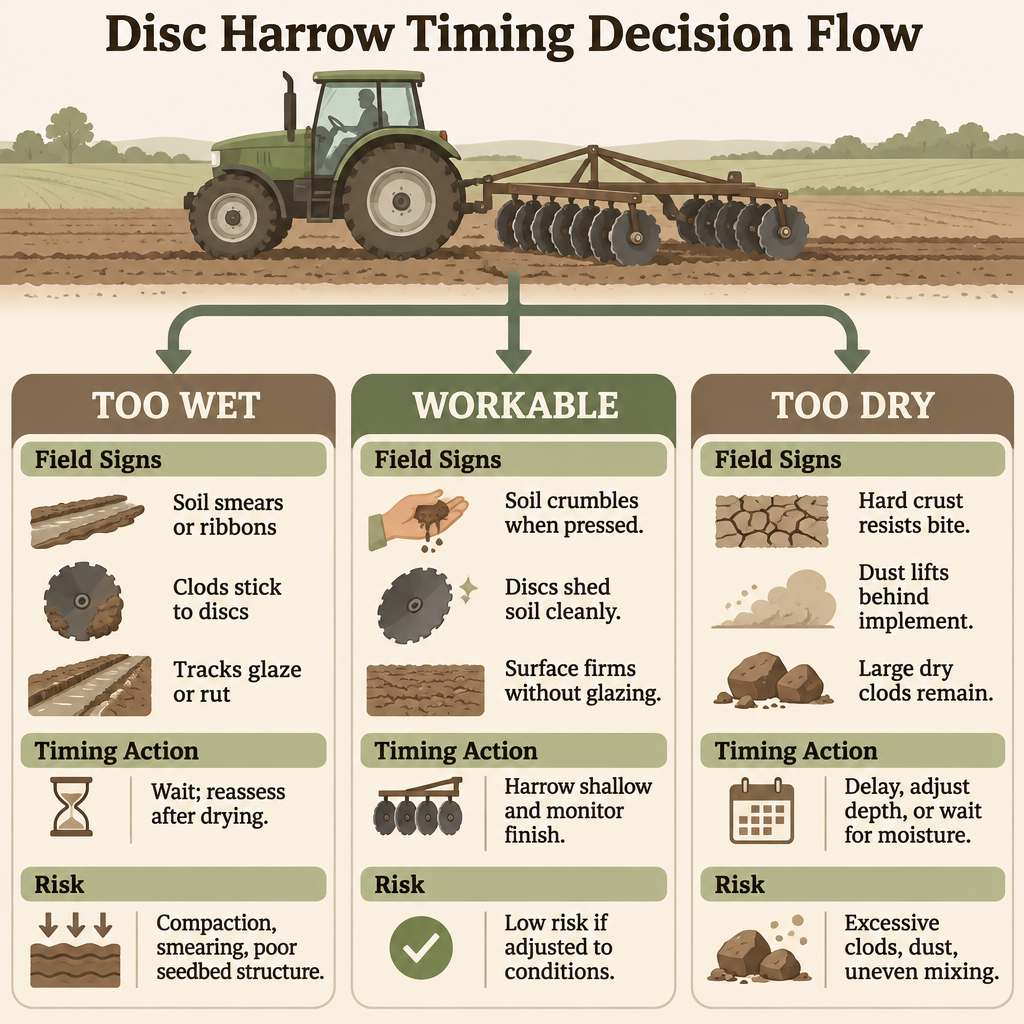
- Check whether recent rain has left the working layer wet enough to smear or compact; if so, wait for better drainage rather than relying only on tractor pulling ability.
- Look at the intended job: smoothing plowed soil, preparing tilth and managing residue each require soil that can be cut and mixed consistently.
- Consider depth before dispatching the implement; Purdue Extension notes that shallow discing can require less horsepower and may allow earlier tillage in wet conditions than deeper systems, but repeated shallow work can still form a pan at the tillage depth.
- Match the timing to erosion exposure; a pass that buries too much protective residue before a rain or wind event can create a different risk than the one it solves.
Match the disc harrow setup to moisture, residue and tractor limits
Disc harrow selection should consider soil condition, target depth, residue load, drainage, blade choice, implement weight, gang angle and tractor power before model or width discussions begin.
| Field condition | Selection implication | Buyer check |
|---|---|---|
| Wet or poorly drained soil increases the risk of uneven incorporation, clods and compaction. | Avoid assuming deeper discing is better; shallow systems may be more adaptable in marginal wet conditions, but repeated shallow use can still create a pan. | Confirm drainage, recent rainfall and whether the field can crumble instead of smear. |
| Fields with heavier residue need attention to how much residue the pass should cut, mix or leave on the surface. | Smooth and scalloped blades suit different residue conditions, so blade discussion should follow residue goals. | Confirm previous crop, residue level and desired surface cover after the pass. |
| Deeper disc harrowing performance varies with blade size, spacing, weight, gang angle and soil conditions. | Tractor horsepower and implement geometry should be matched to the intended working depth, not chosen by width alone. | Prepare tractor horsepower and desired working width before requesting a quotation from DADI Machinery. |
- Ask whether the operation is shallow residue mixing or deeper soil movement.
- State whether residue should be incorporated aggressively or partly retained for cover.
- Describe soil texture, drainage and recent moisture conditions rather than asking only for a general “wet soil” recommendation.
- Provide product type, tractor horsepower, working width, quantity and destination when asking DADI Machinery for quotation support.
Balance residue incorporation with erosion control
Residue management should affect disc harrow timing because the same pass that improves incorporation can also reduce protective cover and change erosion exposure.
| Timing choice | Potential benefit | Risk to manage |
|---|---|---|
| Fall disking | Can save spring field time. | Can increase erosion risk when residue cover is reduced before exposed weather periods. |
| Spring disking on adequately drained, lighter-textured soils | Can fit seedbed preparation closer to planting when conditions are suitable. | If soil remains wet, the pass may still create clods and compaction. |
| Residue-focused disking | Can help smooth plowed soil and prepare tilth while managing crop residue. | The amount of residue left depends on crop residue and tillage intensity, so surface protection should be checked after the pass. |
Data to confirm before a disc harrow quotation
Before requesting a disc harrow quotation, collect the application data that affects selection: product type, tractor horsepower, working width, quantity, destination and the field conditions that shape timing and depth decisions.
- Product category needed, such as disc harrow or related farm implement.
- Available tractor horsepower and target working width.
- Required quantity and shipment destination for quotation preparation.
- Soil moisture pattern, drainage class and whether wet passes have previously caused clods or compaction.
- Expected working depth and whether repeated passes at the same depth are part of the operation.
- Residue condition, crop history and the desired balance between incorporation and surface cover.
- Current maintenance manual for the quoted configuration, including blade and wear-part checks, bearing or service-point requirements, safe cleaning limits and storage requirements.
During the quotation process, buyers should request current model specifications, configuration options, maintenance documents and written commercial terms directly from DADI Machinery.
Conclusion
The best disc harrow timing is the point where soil is dry enough to cut and mix without wet smearing, yet not managed so aggressively that residue cover and soil structure are sacrificed.
- Do not treat tractor traction as proof that the field is ready.
- Match depth, horsepower and implement setup to soil condition and repeat-use risk.
- Include residue and erosion goals in the timing decision.
- Bring field, tractor and quotation data together before asking for a disc harrow recommendation.
FAQ
These quick answers help buyers turn soil-moisture observations into better disc harrow timing and specification conversations.
How does soil moisture affect disc harrow performance?
Moisture affects whether the disc blades cut and mix soil or instead smear wet soil, leave clods and contribute to compaction below the working layer.
Why is discing wet soil risky?
Wet disking can cause non-uniform incorporation, clods that require additional tillage and a compacted layer below the disking depth.
How soon after rain should a disc harrow be used?
Use field condition rather than a fixed day count: wait until the soil can be worked for smoothing, tilth and residue management without wet smearing or compaction.
Is shallow discing better than deep discing in marginal moisture?
Shallow discing may require less horsepower and may be possible earlier in wet conditions than deeper systems, but continuous shallow use can still form a pan at the tillage depth.
How does residue change the moisture decision?
Residue level affects blade choice, pass intensity and surface cover after disking, so residue goals should be reviewed with soil moisture and erosion exposure.
What should a buyer prepare before requesting a disc harrow quote?
Prepare product type, tractor horsepower, working width, quantity and destination, then add soil moisture, drainage, residue and depth expectations for a more useful recommendation.
Is there one ideal soil moisture percentage for disc harrowing?
A single universal percentage is not a reliable buying rule because soil conditions, drainage, depth, implement weight, gang angle and residue conditions change the decision.