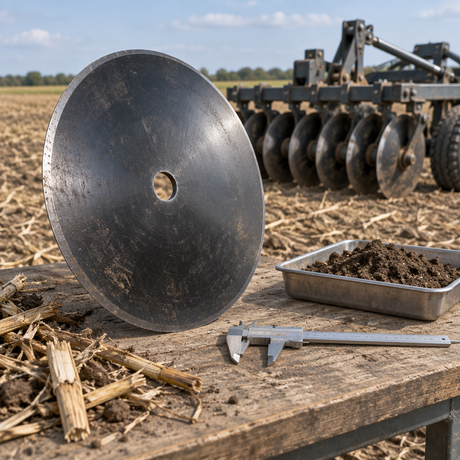
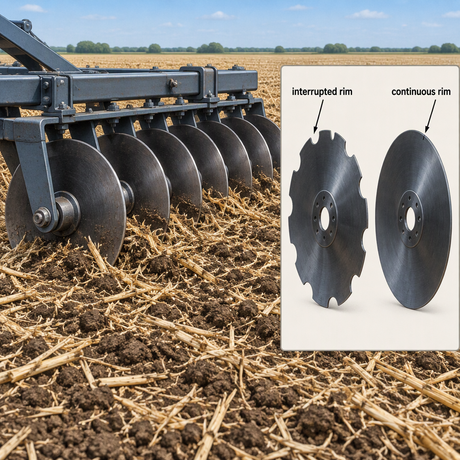
Choose notched (scalloped) blades when the priority is cutting heavy residue and biting into hard, crusted or cloddy ground; choose plain (smooth) blades when you want a level, consolidated finish with less pulverising of the soil you are trying to protect. Most mixed fields do not need one answer for the whole machine: a scalloped front gang that cuts residue first, with a plain rear gang that levels and firms behind it, is the arrangement used on DADI Machinery's 1BJX series medium disc harrow.
Notched vs. plain disc blades: what actually differs?
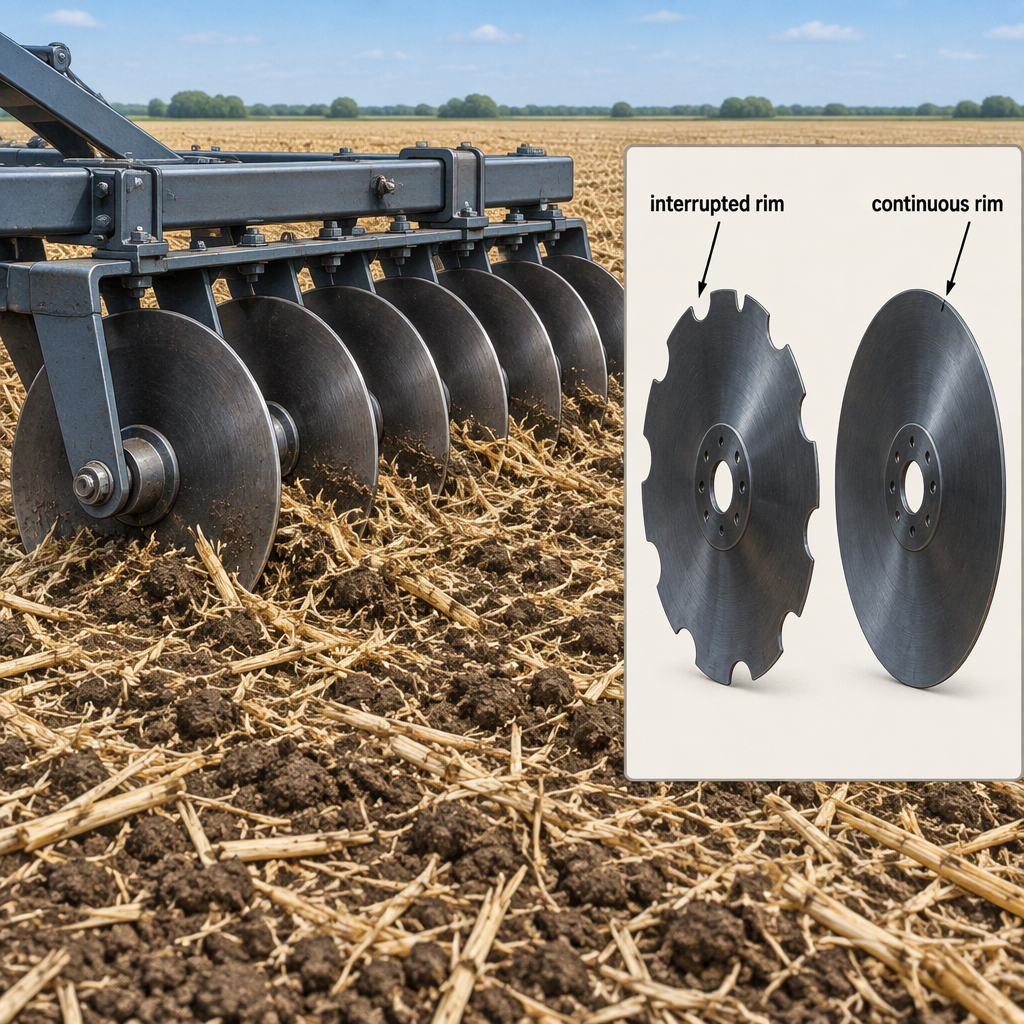
The difference is the rim. A notched blade, also called scalloped, has an interrupted cutting edge formed by shallow scallops; a plain blade, also called smooth, has a continuous circular edge. Almost everything the blade does afterwards — how firmly it grips residue, how much soil it lifts and inverts, how fine the tilth is left — follows from that edge together with gang angle, working depth, forward speed and the down-pressure you set.
Notched (scalloped) blade
- Cutting edge: interrupted rim of shallow scallops.
- Primary job: grip, cut and size residue and clods so material passes through the gangs.
- Usual position: front gang in a mixed set.
- Finish left: rougher, more loosened surface.
- Main caution: mixes and buries more residue than a plain rim.
Plain (smooth) blade
- Cutting edge: continuous circular rim.
- Primary job: slice, level, firm and blend what the front gang has lifted.
- Usual position: rear gang in a mixed set.
- Finish left: smoother, more consolidated surface.
- Main caution: can ride over long uncut residue if no front gang has cut it first.
DADI Machinery manufactures and supplies disc harrows, disc ploughs, disc blades, mowers, cultivators and seeders, and its 1BJX series medium disc harrow is assembled with scalloped discs on the front gangs and plain discs on the rear gangs.
In the same catalogue, disc harrows are grouped as light, medium and heavy duty, with a separate harrow disc category for blades. Those groups describe complete machines, so ask for the blade, gang and frame details that belong to the model you are buying.
Which blade handles heavy crop residue?
Heavy residue is normally a job for a notched front gang, because an interrupted rim bites into stalks and cuts them so they can flow through the gangs instead of being pushed ahead of a smooth edge. The trade-off comes in the same pass: disc tillage buries much of the crop residue, can pulverise surface soil and induces compaction immediately beneath the tilled layer, so how much cover survives matters as much as whether the stalks were cut.
| Field and residue situation | Cover you want to keep | Profile to lead with | What to confirm in the field |
|---|---|---|---|
| Tall standing straw or a heavy mat of residue | Seedbed preparation matters more than maximum cover | Notched front gang, plain rear gang | That stalks are cut rather than dragged; check immediately behind the first pass |
| Evenly spread chopped residue | Keep a useful share of the cover | Notched front, plain rear, one pass first | Whether a second pass is actually needed |
| Light residue on fairly even ground | A fine, level finish | Plain discs | That uncut stalks are not riding on top of the surface |
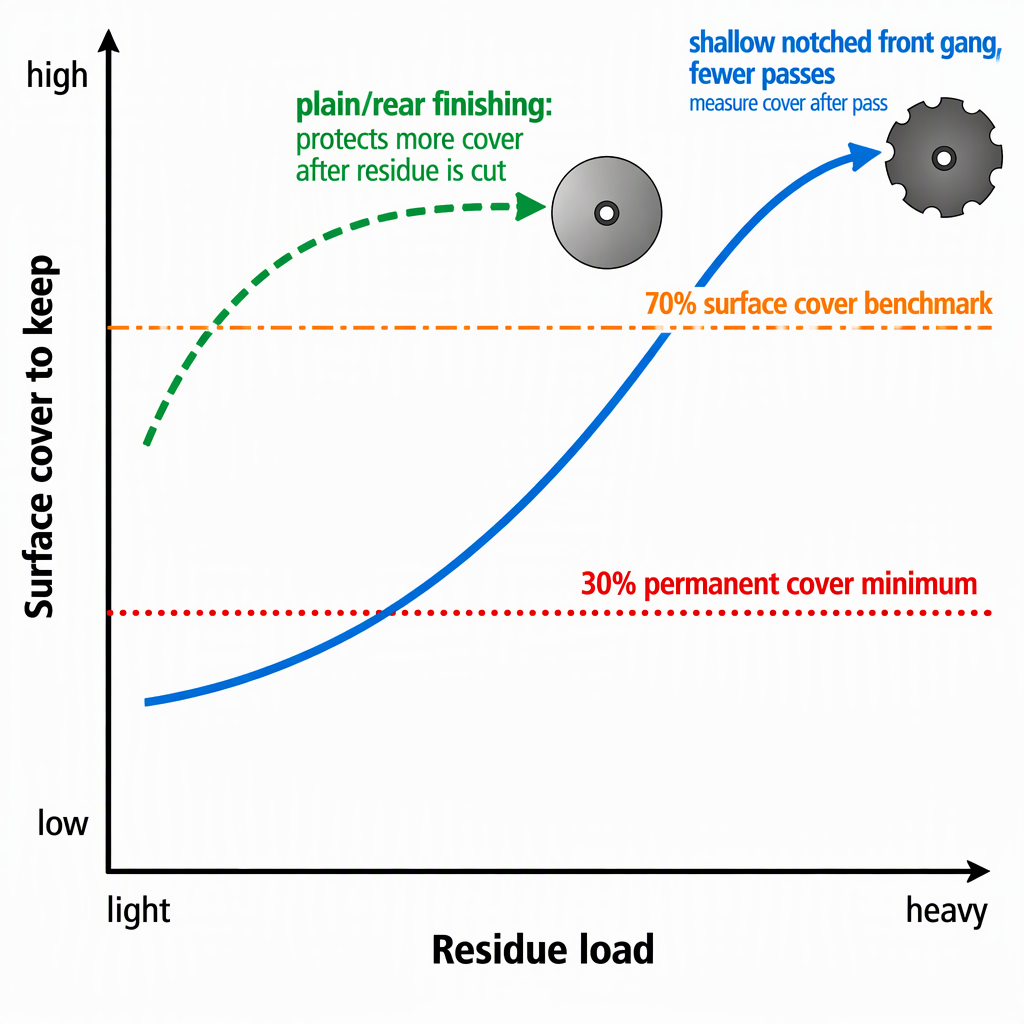
| Heavy residue on erosion-prone ground | Surface cover is a priority | Shallower notched pass, fewer passes | Cover measured after each pass against your own target |
Which blade handles your soil?
Hard, dry, crusted or cloddy ground generally favours a notched rim, which keeps biting instead of skating across the surface; softer, moist or already-worked ground favours a plain rim for a level, firmed finish. Test that logic on your own soil: compacted or sealed pores are a prime reason water fails to enter the soil and runs off, and repeated tillage at the same depth builds a pan that restricts roots and water.
| Decision factor | Notched (scalloped) | Plain (smooth) | How to check it on your field |
|---|---|---|---|
| Cutting residue before it reaches the frame | Interrupted rim grips and cuts | Continuous rim slices and presses | Count stalks still lying loose on the surface after the pass |
| Entering hard, crusted or cloddy ground | Bites across the scallops | Rides more readily on the rim | Compare penetration and clod size at equal depth and speed |
| Finish left behind | Rougher, more loosened | Smoother, more firmed | Judge levelness and how the surface takes the next rain |
| Residue left on the surface | Lower, because more is mixed in | Higher, because less is buried | Measure surface cover instead of judging by eye |
| Disturbance within the working layer | Greater mixing | Less mixing | Dig to working depth and look for smeared or tight layers |
| Typical first fit | Heavy residue, hard or cloddy ground | Lighter residue, finishing a seedbed | Confirm with a same-day strip comparison |
Soil-health management, as described by reducing disturbance and keeping the soil covered, also rests on biodiversity and living roots, and healthier soils lose less water and soil to runoff and hold more water for the crop.
Can you mix notched and plain blades on one harrow?
Yes, and on many farms it is the normal answer rather than a compromise. DADI Machinery's 1BJX series medium disc harrow pairs scalloped discs on the front gangs with plain discs on the rear, so the frame cuts residue and clods at the front and levels and firms behind.
- Which gang is front and which is rear on your harrow model, and how the discs are mounted on each axle.
- The blade diameter, thickness, bore and mounting pattern your model requires, requested in writing rather than assumed.
- Whether the same disc is used on both gangs or whether front and rear differ.
- How many blades each gang and each machine takes, and what the quotation includes.
- Tractor power, weight and hydraulics for the working width and depth you intend to run.
- Whether rear plain blades can be replaced later if residue loads change, and what that takes in labour and parts.
What does an aggressive blade cost you in residue cover?
The cost is on the surface. The more a blade cuts, lifts and mixes, the less residue remains on top, and residue cover absorbs raindrop energy and limits surface crusting and runoff. Regular shallow disc or tine tillage to break crusts is not recommended, disc use in particular often causes compaction that can impede root growth and rainwater percolation, and tillage also accelerates the loss of organic matter and pore stability.
If the field has to keep a protective cover, fix a target before the season starts. FAO defines conservation agriculture around minimum mechanical soil disturbance, a permanent soil cover of at least 30% and species diversification.
Where soil loss is the specific concern, the figure quoted for zero-tillage systems is around 70% surface cover, roughly 4–6 t/ha of maize straw. Use these as cover levels to measure against, not as results produced by any one blade.
Watch the surface and the layer just below your working depth as well: raindrop impact breaks surface aggregates, seals pores and forms crusts that reduce infiltration, and a plough pan can develop just below tillage depth.
Practical response: reduce depth, reduce pass count and slow down before switching to a more aggressive edge, and if cover retention is a hard requirement for the field, plan the notched discs for the front gang only.
How does blade profile change the real cost per hectare?
Blade profile changes cost per hectare mainly through how many passes you make and what each pass consumes — fuel, labour, time and wear — rather than through a fixed price difference between two blade types. Systems built on minimum soil disturbance are noted for lower labour, machinery and fuel costs than tillage-based systems, so the cheapest workable answer is usually the one that reaches your residue and seedbed goal in the fewest passes without taking more cover off the field than it can afford to lose.
- The harrow model and gang layout the blades are for: notched front and plain rear, or one edge throughout.
- Blade diameter, thickness, bore and material specification for that model, requested in writing.
- Quantity per gang and per machine, and whether mounting hardware is included.
- Availability of replacements for the blades that will wear fastest, so a mid-season change stays possible.
- Written commercial terms: price validity, delivery, packing and payment.
- Your own numbers: planned passes, depth, speed, fuel, labour and the cover you are prepared to lose.
How do you verify the choice in your own field?
Compare the two profiles on the same field, on the same day, at the same depth and speed, and judge the result on measured outputs: residue cover left on the surface, clod size, levelness, stalks left uncut, any tight layer below the working depth, and the fuel and time each pass cost.
- Mark two adjacent strips with the same soil, residue load, slope and moisture, and note the field's erosion risk before you start.
- Set both passes to the same working depth and forward speed, and keep every other implement setting equal.
- Before any manual work on the machine — clearing a blockage or checking blade edges — switch off the tractor engine, remove the key and disconnect the battery or isolate the power source, then work only within the access the operator manual permits.
- After each pass, measure surface cover instead of estimating it; a line transect or quadrat photographs are enough. FAO's indicative minimum for permanent soil cover is 30%, and soil-loss control work in zero-tillage systems quotes about 70% surface cover. Compare your own figures with the target you set for the field.
- Record clod size, levelness, penetration and how many stalks were left lying on the surface.
- Log fuel used, time and labour per hectare for each strip so the comparison covers cost as well as tilth.
- After rain or at the end of the season, dig a small pit in each strip to working depth and look for a compacted layer just below it. Repeated tillage at the same depth is what builds those subsurface pans; if you find one, change depth or timing rather than adding passes.
- Repeat the comparison on more than one field and across a wet and a dry period before changing the blade specification across the whole farm.
What should you order next?
Order for the field that gives you trouble, not for the average: match the edge profile to your residue load and soil condition, and where the field is mixed, order the arrangement that cuts first and finishes second. Then confirm fitment, quantity and written terms against your own harrow model, and prove the choice in one measured strip before it goes across the farm.
Bring three details to any blade or harrow discussion: the harrow model and gang layout you run, the residue load and soil condition you actually work in, and the cover you need to keep for erosion control. Those three answers decide whether the front gang should be notched, whether the rear gang stays plain, and how many passes the field can take before the cost in fuel, time and lost cover outweighs the benefit.
Frequently asked questions about notched and plain disc blades
These are the questions buyers raise most often once the profile choice is narrowed down.
How much residue cover should be left after a pass?
Set the figure from the field's erosion risk rather than from a universal number, and start from the conservation principle of a permanent soil cover of at least 30%.
Where soil loss is the main concern, zero-tillage work quotes around 70% surface cover, about 4–6 t/ha of maize straw, as the protective level.
Measure what is actually left after the pass and compare it with your target. If the figure is too low, reduce depth or pass count before you change the blade.
Do notched blades work in light sandy soil?
They can be used, but in light, open soil there is less structure to break up and residue breaks down faster, so the aggressive-cutting benefit is smaller.
Where pores are compacted or sealed, water cannot enter the soil and runs off instead.
On sand, start with a plain or lightly notched profile at shallow depth, and increase edge aggression only if you see uncut residue or crusting.
How do I check whether my current blades are worn before ordering?
Work safely first: park on level ground, lower the implement, switch off the tractor engine, remove the key and disconnect the battery or isolate the power source before you touch the gangs, then work only within the access the operator manual allows. Inspect the edge of each disc for rounded scallops, chips, cracks or distortion, compare discs across the gangs for uneven wear, and check the mounting hardware against the torque figures in your manual.
Replace on the criteria your manufacturer sets rather than a guessed interval, and if you cannot find the wear criteria for your machine, request the applicable document with your quotation.
Do two shallow disc passes replace one deeper pass?
Not automatically, and rarely cheaply. Repeated tillage at the same depth can build a compacted layer beneath the working zone, and disc work in particular often causes compaction that restricts roots and water movement.
Two shallow passes also carry twice the fuel, labour and time of one pass. If you do repeat a pass, vary the depth or the tool and then check penetration, clod size and the layer under the tilled zone before making it routine.
Can I use notched blades on the rear gang too?
Some buyers order one edge throughout. DADI Machinery's 1BJX series medium disc harrow pairs scalloped front discs with plain rear discs.
With notched discs on both gangs, expect a rougher, more mixed finish and more residue buried. Confirm that the model accepts the same disc on both gangs, and check one strip first.
What should I include when requesting a disc blade quotation?
- Your harrow model, its gang layout, and the number of blades per gang and per machine.
- The blade diameter, thickness, bore and material specification your model requires.
- Whether mounting hardware is included and whether blades are quoted for front and rear gangs together.
- Destination, packing, and the commercial terms you need confirmed in writing.
Which blade suits a lower-powered tractor?
The load on the tractor comes from working width, depth, speed, soil condition and gang setting as much as from the blade edge, so ask the supplier for the recommended power range for the specific harrow model and compare it with your tractor's power, weight and hydraulics.
Then confirm it in one strip at the depth and speed you intend to work.