

Disc plough
Use it when the tillage goal is ploughing or more intensive soil disturbance before later finishing passes.
Views: 0 Author: Site Editor Publish Time: 2026-11-16 Origin: Site


Choose a disc plough when the job is primary, more intensive soil opening; choose a disc harrow when the job is secondary leveling, residue cutting and seedbed preparation after or between primary tillage passes.
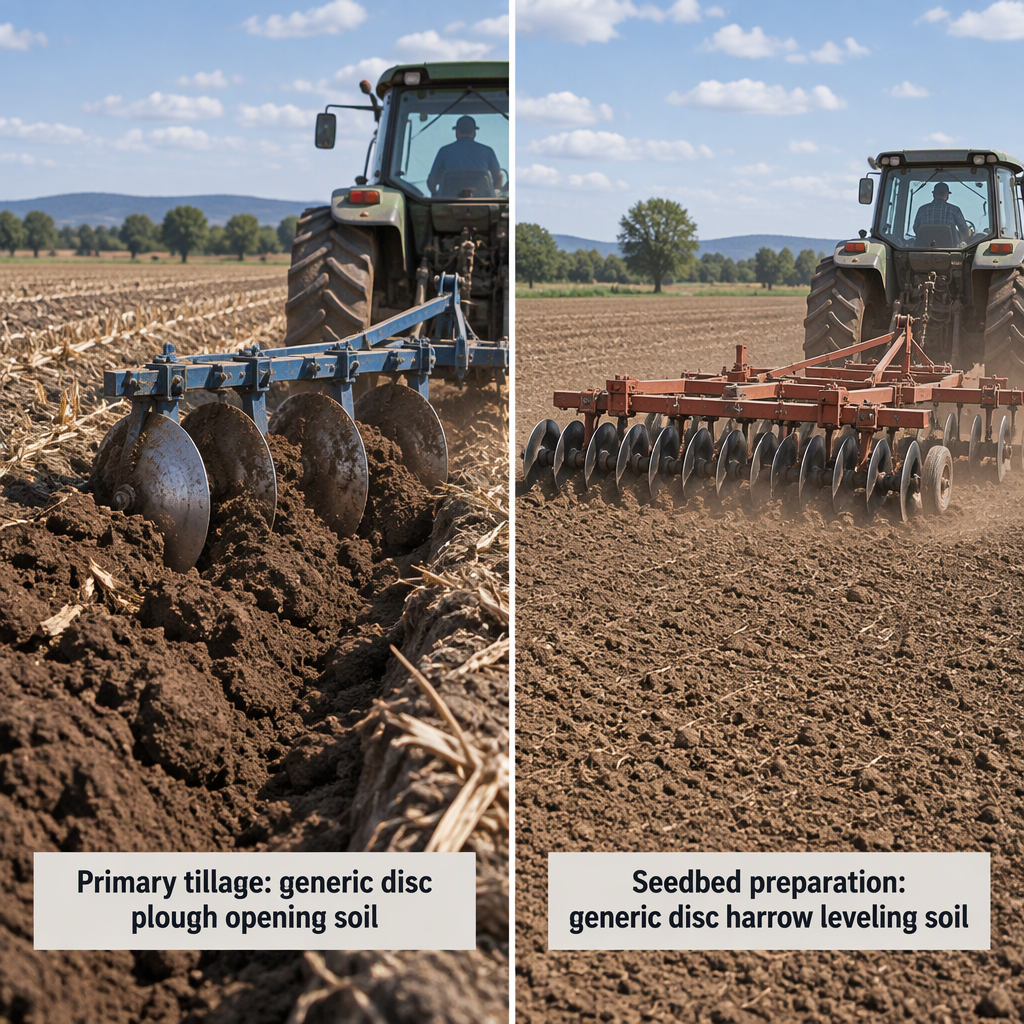
A disc plough is normally selected for primary tillage, while a disc harrow is normally selected for secondary tillage that smooths ploughed soil and prepares tilth for planting, as explained by NC State Extension’s disk tillage guidance.
Use it when the tillage goal is ploughing or more intensive soil disturbance before later finishing passes.
Use it when the tillage goal is smoothing a ploughed surface and preparing a more even seedbed.
For dealers and implement buyers, the practical question is not which name sounds heavier; it is whether the field needs a first soil-opening pass or a finishing pass that prepares the surface for planting.
| Decision point | Disc plough | Disc harrow |
|---|---|---|
| Main tillage role | Primary ploughing or intensive tillage. | Secondary smoothing, leveling and tilth preparation. |
| Field result to check | Soil opening without creating clods or compaction in unsuitable moisture. | Residue cutting, soil slicing and surface leveling affected by blade and gang setup. |
| Procurement focus | Match tractor power, working width, soil condition, crop type and application need. | Match the same tractor and field variables before quotation. |
Choose a disc plough when the first requirement is primary tillage rather than final seedbed finishing.
For buyers comparing listed models, DADI Machinery’s pipe disc plough page presents fields such as working depth, working width, disc quantity, disc diameter, weight, matched power and three-point-mounted linkage for its pipe disc plough line.
That type of model table is useful because it moves the discussion from a generic implement name to measurable fit: depth, width, weight, disc arrangement and tractor match can be checked against the actual tractor and field before a quote is finalized.
Before a dealer quotes or a farm buyer orders, DADI Machinery’s service and support page asks buyers to share tractor power, target working width, soil condition, crop type and application need for model matching.
Choose a disc harrow when the job is to cut residue, level the field and prepare a smoother planting surface after primary tillage or in a suitable reduced-pass system.
Blade edge, diameter, spacing, concavity, material and gang arrangement influence residue cutting and soil slicing.
Single, offset and tandem arrangements serve different residue and field needs, so the buyer should compare arrangement as well as working width.
A harrow comparison should therefore include the arrangement and blade details, not only the nominal working width. Two tools with similar width can behave differently when residue level, blade spacing or gang arrangement changes.
The right choice depends on the tillage goal plus soil condition, residue load, moisture, weather risk and crop system; those factors should be checked before selecting either implement.
| Field condition | What to check | Selection implication |
|---|---|---|
| High residue | Confirm blade and gang arrangement for cutting and incorporation. | Compare harrow configuration carefully; do not choose by width alone. |
| Wet soil | Look for moisture conditions that may cause clods, uneven incorporation or compaction. | Delay or adjust the pass rather than forcing either tool into poor conditions. |
| Erosion-prone timing | Consider wind and water erosion risk when scheduling disk tillage. | Match the tillage pass to weather and conservation needs. |
| Soil and terrain variation | Soil and topographic conditions influence tillage tool type, size and shape in general tillage planning. | Use field observation and local agronomy practice to narrow the implement choice. |
Under the same farm conditions, the comparison should be made on the intended pass and expected field result: soil opening, residue incorporation, leveling or final seedbed preparation.
Match the implement to the actual tractor and field job by confirming tractor power, working width, soil condition, crop type and application need before ordering.
For procurement teams, this keeps the specification conversation concrete. The same implement category can be unsuitable if tractor power, linkage, working width or crop application does not match the field job.
Field capacity depends on speed, working width and field efficiency, so tractor matching should be checked against the actual work rate the buyer expects to achieve.
Compare total machine economics, not only purchase price: ownership costs, operating costs and field capacity together drive cost per acre.
| Cost area | What belongs in the comparison | Buyer action |
|---|---|---|
| Ownership cost | Depreciation, interest, taxes, insurance and housing. | Estimate annual ownership cost for the expected years and acres of use. |
| Operating cost | Repairs, fuel, lubrication and labor. | Compare likely operating inputs under the same field conditions. |
| Cost per acre | Combined cost per hour divided by field capacity. | Measure speed, working width and field efficiency before comparing tools. |
A wider tool may improve field capacity only when tractor power, speed, soil condition and field efficiency support the wider pass. A narrower tool may be more practical when turning space, soil condition or tractor match limits the work rate.
Operational checks should focus on blade condition, gang setup, residue flow, soil moisture and the finished field result.
The field result after the first strip is the buyer’s reality check. If the pass is producing clods, uneven incorporation or compaction signs, the schedule, setting or tool choice should be reconsidered before completing the field.
Before quotation, measure the field and tractor variables that affect implement fit: power, width, soil condition, crop type, residue, application need, speed and expected field efficiency.
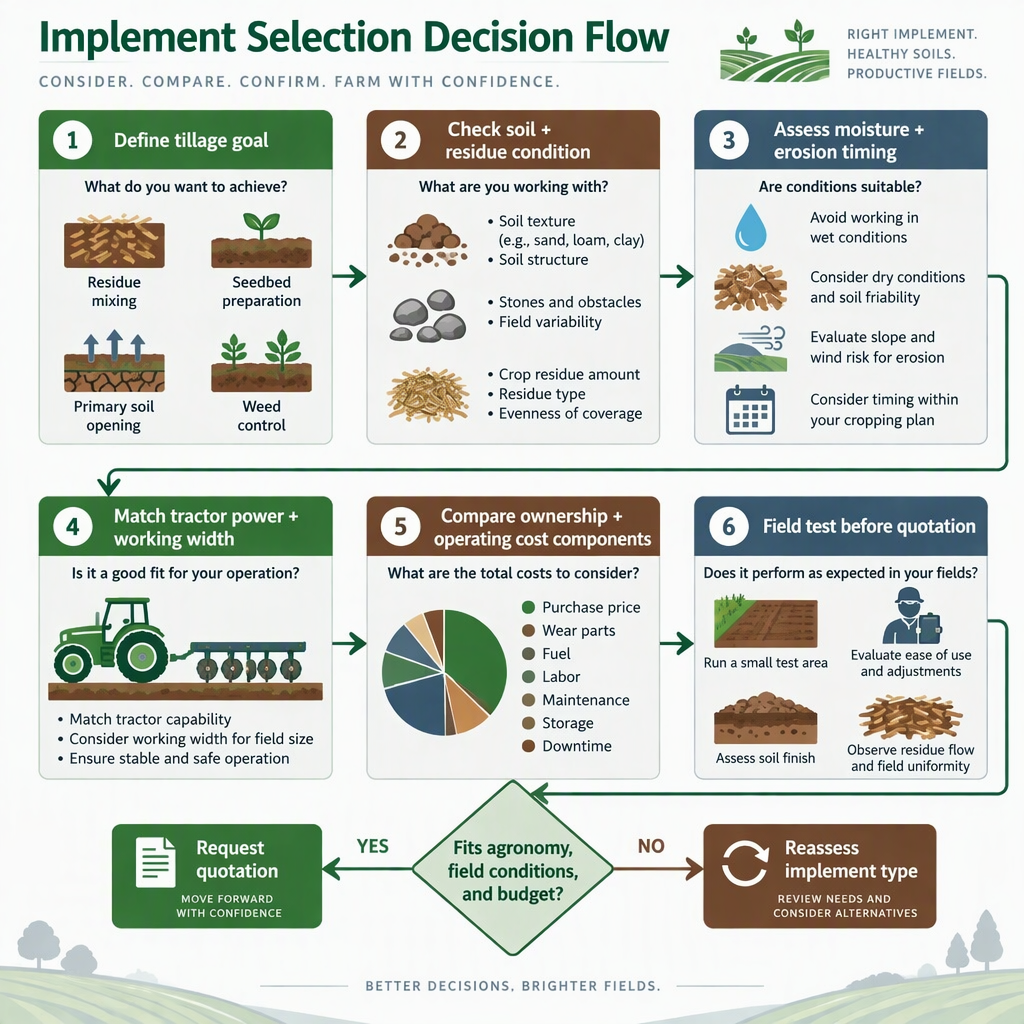
When two options appear technically possible, compare them under the same width, speed, efficiency and cost assumptions. Otherwise, the quotation may compare different jobs rather than different tools.
Quotation prep: compare field and tractor requirements before quotation by listing power, width, soil condition, crop type and application need.
The better choice is the implement that matches the tillage job: disc plough for primary soil opening, disc harrow for secondary leveling and seedbed preparation.
These buyer questions help narrow the choice without relying on unsupported universal prices, horsepower rules or brand superiority claims.
No. A disc plough is associated with primary ploughing or intensive tillage, while a disc harrow is associated with secondary smoothing and seedbed preparation.
Yes, when the agronomic plan calls for a secondary pass to smooth the ploughed soil surface and prepare tilth for planting.
Use caution. Running disks in wet soil can create clods, uneven incorporation and compaction problems, so soil moisture should be checked before operation.
Do not rely on a universal horsepower rule. Match the specific implement to tractor power, working width, soil condition, crop type and application need.
The answer depends on ownership costs, operating costs and field capacity, not just purchase price.
Working width affects field capacity, and field capacity is part of the cost-per-acre calculation.
Check blade edge, diameter, spacing, concavity and gang arrangement because those features influence residue cutting and soil slicing.
Prepare tractor horsepower, working width, soil condition, crop type and application need so the supplier can compare suitable model options.


