

close
Choose Your Site
Global
Social Media
Views: 0 Author: Site Editor Publish Time: 2026-09-04 Origin: Site


Are you unsure whether to pick a disc harrow or a moldboard plow for your next tillage pass? Your choice depends on soil type, how deep you need to go, how you handle leftover crop residue, and your budget. Each tool has its own special job.
A disc harrow works great for second tillage, getting seedbeds ready, and saving fuel. It mixes leftover plant material and breaks up hard soil clumps well. A moldboard plow is the best for turning soil over deeply and burying heavy residue. It flips the soil completely.
This article helps you match the right tool to your farm's unique needs. You will see how each machine performs in different situations. You will find out which one saves you money and time. By the end, you can make a sure and smart choice for your land.
Disc harrows are best for light soil work and getting the ground ready for planting.
Moldboard plows dig deep into soil and bury heavy residue.
Disc harrows use less fuel and require less tractor power.
Moldboard plows need more fuel and bigger tractors to run.
Pick a disc harrow when your soil is sandy or loamy.
Pick a moldboard plow when your soil is heavy clay.
Disc harrows keep crop residue on the soil surface to stop erosion.
Moldboard plows fully bury leftover crop material, but they raise the chance of soil erosion.
A disc harrow is a farming tool with rows of curved steel discs. As the tractor pulls it, the discs slice into the ground. Each disc spins on its own axle. The curved shape lifts soil, breaks up clumps, and mixes leftover plants as it turns. Farmers use this flexible tool for many jobs in different field conditions.
The disc harrow does several key jobs in modern farming. Its design lets one machine handle many tasks well.
Primary Tillage: Breaking up hard, packed soil before planting
Secondary Tillage: Smoothing soil after plowing to make a fine seedbed
Weed Control: Pulling up weeds and mixing them into the soil to cut down on herbicide use
Residue Management: Chopping and mixing leftover crop stalks to boost soil organic matter
Soil Aeration: Loosening packed soil to help water soak in and roots grow
Seedbed Preparation: Making a flat, even seedbed for uniform seed sprouting
The disc harrow also helps spread fertilizers evenly through the soil. It breaks the hard top layer to improve water flow and drainage. You get exact land prep with even air and leveling for better farming.
Manufacturers build disc harrows in three main setups. Each design serves a different purpose.
Tandem disc harrows have two sets of discs facing opposite ways. This setup works well for lighter tillage and finishing seedbeds. The overlapping action levels the soil well.
Offset disc harrows place the disc sets in a staggered layout. This setup cuts deeper and handles heavier residue. You get better soil penetration in tough conditions.
Single disc harrows use just one set of discs. Farmers use them for shallow mixing and light cultivation jobs.
The blades come in many sizes and shapes. High-carbon or boron steel makes them strong and long-lasting. Disc widths range from 16 to 36 inches, with thickness from 3 to 10 mm. Bigger sizes handle heavy-duty work. Edge styles include notched, smooth, or mixed types. Notched edges slice through tough residue better. Heat treatment makes the blades harder and more wear-resistant for a longer life.
A disc harrow works for both primary and secondary tillage. For primary tillage, you use a heavy-duty model to break new ground. DADI MACHINERY's 1BZ Heavy-duty Disc Harrow is great for this job. It clears plant stubble, crushes clumps, and gets heavy clay soil ready for planting.
For secondary tillage, you use the disc harrow after moldboard plowing. The discs break up the soil more. They make a smooth, level seedbed ready for planting. This dual ability makes the disc harrow a smart buy for your farm.
The disc harrow works in many soil types. You can use it in sandy, loamy, or clay fields. But hard, dry soils need heavier harrows with bigger discs to dig in well.
Sandy and loamy soils work best with disc harrow tillage. Smooth or mixed blades do well in these soils. The discs cut through loose soil easily. They mix residue without pushing it too deep. Loam and silt loam soils give the most flexibility. You can use smooth or notched blades well in these fields.
The disc harrow works in a clear order:
The curved discs spin naturally as the tractor pulls the tool
The discs sink into the soil because of their shape and weight
Soil clumps break into smaller pieces by the disc edges
Crop leftovers mix into the soil through the disc's spin and angle
Weeds get pulled up or buried during the process
The field becomes level and ready for planting
For clay or heavy soils, you need notched blades to dig in better. Don't work clay when it's too wet to avoid smearing. Fields with lots of residue also benefit from notched or fluted blades. These designs cut through tough plant material well.
The moldboard plow is one of farming's oldest and strongest tools. It started in China's Han Empire during the 1st and 2nd centuries. Later, the design reached the Netherlands and helped start the Agricultural Revolution. You may know John Deere from today's tractors. In 1837, Deere built a steel moldboard plow that cleaned itself as it worked. This solved the problem of sticky prairie soil. Experts rank this invention among the top five most amazing tech achievements in farming history. It helped people settle all the land west of the Mississippi River.
As scholar Francesca Bray notes: "Chinese ploughs from Han times on fulfill all these conditions of efficiency nicely... pre-eighteenth century mould-boards were usually wooden and straight... The enormous labour involved in pulling such a clumsy construction necessitated large plough-teams... In China, where much less animal power was required, it was not necessary to maintain the mixed arable-pasture economy typical of Europe."
The moldboard plow grew from simple scratch plows that only cut a line in the dirt. The big new idea was the curved moldboard itself. This large metal piece lifts, twists, and rolls the soil slice to one side. It makes a clean furrow and covers everything on top.
The moldboard plow turns soil over completely using parts that work together. Instead of smashing or breaking the soil, it lifts, turns, and lays it down in one smooth move.
Three main parts work together on each plow bottom. The share cuts the soil at the bottom of the furrow. A Number-Five Kvernland-style share works well even in heavy clay soils. The moldboard is the most important part. Its very long length and carefully set angles slowly roll the soil. This slow action lets the furrow slice make a full 180-degree turn. The result is a fully buried finish where sod or cover crops are completely covered. The landside pushes against the furrow wall. It takes in the sideways force of plowing and keeps the plow going straight.
A moldboard plow digs deeper than most tillage tools. You can usually set it to cut 6 to 14 inches into the ground. This depth lets you break through hardpan layers that stop root growth and water flow. When you flip the soil, you bring fresh, nutrient-rich dirt to the top. You also make drainage furrows that let extra water escape. This helps a lot in heavy northern European clay soils.
The moldboard plow works best in certain farming situations. You need to match the tool to your field for the best results.
Farms that rotate crops with lots of leftover plant material benefit most from moldboard plowing. Corn-corn fields leave heavy stalks that other tools cannot bury fully. The moldboard plow covers all this residue completely. It also buries weeds and plants on the surface. This was a big advantage before modern herbicides existed. The turning action also mixes in manure and soil additives. You get a clean seedbed ready for the next crop.
Think about using a moldboard plow when turning unused land into active fields. It also works well in cool, damp climates. The plow improves soil drainage and helps the ground warm up faster in spring. Hard, packed soils respond well to deep turning. The plow breaks up dense layers that stop plant growth. This makes it better than reduced-tillage options in these cases. You must weigh the known downsides of erosion and soil disturbance against these benefits.
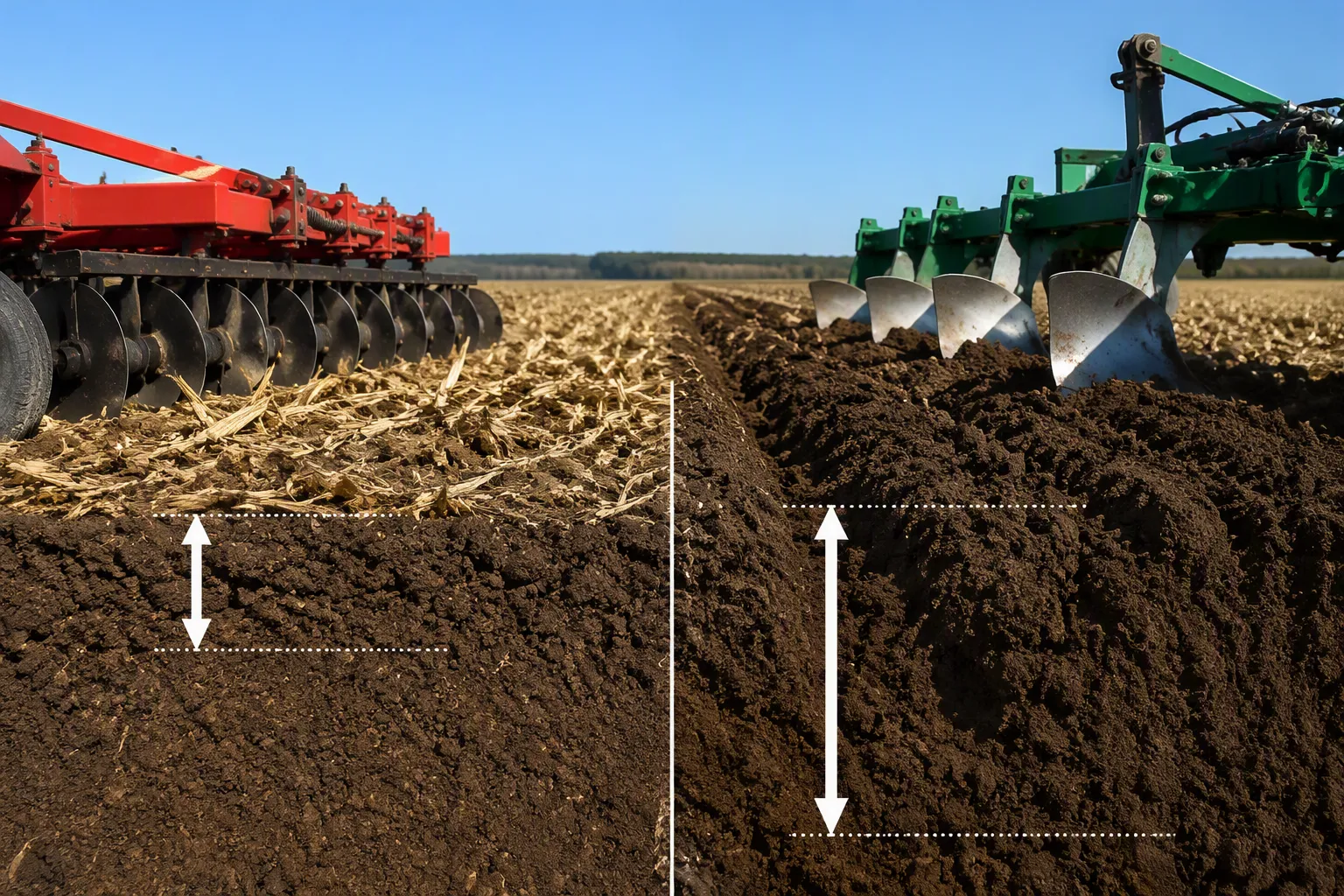
Now you know how each tool works by itself. The real question is how they compare when you use them side by side in the same field. Three big differences set these tools apart: working depth, soil compatibility, and residue handling. Each difference changes how you manage your land during the season.
Working depth is the clearest difference between these two tools. A disc harrow usually cuts only 4 to 8 inches into the soil. This shallow depth works fine for seedbed prep and mixing surface residue. The moldboard plow goes much deeper, cutting 6 to 14 inches below the surface. That extra depth lets you break up hardpan layers that stop root growth and trap water.
Soil inversion shows an even bigger difference. The moldboard plow turns soil almost completely upside down. Research using ceramic tracers shows this effect clearly. At a working depth of 25 to 30 centimeters, the plow buried tracers to an average depth of 12.7 centimeters. Only 4 percent of those tracers stayed in the top 4 centimeters of soil. The disc harrow works very differently. It does not invert soil at all. In one study, only 10 percent of dyed soil from the top 10 centimeters moved to deeper layers. This small movement means residue stays near the surface where it can break down slowly.
Implement | Soil Inversion | Residue Burial Depth | Residue Left on Surface |
|---|---|---|---|
Moldboard Plow | Almost complete inversion | 10–14 inches (25–36 cm) | Minimal |
Disc Harrow | Slight inversion | 2–12 inches (5–30 cm) cutting depth | 40–70% |
This table shows what each tool does in practice. You pick the moldboard plow when you need full turnover. You pick a disc harrow when you want to keep organic matter near the top.
Your soil type should guide your choice more than anything else. The disc harrow works best in light to medium soils. Sandy and loamy fields let the curved discs dig in easily without too much pull. You can work these soils soon after rain without causing harm. The discs cut through loose material and mix it well.
The moldboard plow works best in heavy clay soils. Its sharp share cuts a clean line through dense ground. The curved moldboard then lifts and turns the heavy soil without smearing or packing the furrow bottom. Clay soils benefit from this deep turning because it improves drainage and warms the soil faster in spring.
Moisture matters for both tools. You should never work clay soil with a disc harrow when it is too wet. The discs will smear the soil and create a hardpan. The moldboard plow handles wetter conditions better because its design lifts soil rather than pushing it sideways. However, very wet ground will clog any tool. Test your soil by squeezing a handful into a ball. If it crumbles when you poke it, the moisture level is right for tillage.
Residue management sets these tools apart in ways that affect your next planting season. The moldboard plow buries nearly all surface residue. This full burial gives you a clean, dark field ready for planting. It also helps control certain diseases by removing infected plant material from the surface.
The disc harrow takes a different approach. It chops residue into smaller pieces and mixes them through the top few inches of soil. This leaves 40 to 70 percent of residue on the surface. That remaining cover protects soil from wind and water erosion. It also helps keep soil moisture during dry spells.
Weed control follows a similar pattern. The moldboard plow pulls up weeds and buries their seeds deep below the germination zone. It handles both small weeds and large perennials well. However, this deep burial has a downside. The plow can bring previously buried seeds back to the surface where they sprout. The disc harrow chops weeds into pieces and separates roots from soil. This works well for small seedlings but fails against established perennials. Its shallow burial does not stop weed seeds from coming up.
For weed species that cannot survive deep burial, moldboard plowing reduces weed density over several years. Species like ivyleaf morningglory, which emerge from depths of 2 inches or more, may actually increase with regular plowing. You must know your weed types before choosing your tillage strategy.
The disc harrow offers more flexibility for conservation-minded farmers. You can adjust its working angle to control how much residue you bury. This lets you balance erosion protection with seedbed prep. The moldboard plow gives you no such adjustment. It either buries everything or nothing.
Your choice ultimately depends on your specific weed pressures and residue goals. Match the tool to your field conditions, and you will see better results.
Your budget plays a big part in picking between these two tillage tools. The price tag only shows part of the picture. Operating costs, fuel use, and long-term soil health all affect your profits. You must look past the sticker price to see the real cost of each tool.
A good disc harrow often costs more upfront than you might think. Heavy-duty models with boron steel blades and strong frames cost more than light-duty ones. DADI MACHINERY offers fair prices on its 1BZ Heavy-duty Disc Harrow, making this purchase easier for farms of all sizes.
The starting cost pays off through lower running costs. Disc harrows have fewer parts that wear out fast. The blades last for years with good care. You can swap out single blades when they wear down instead of buying whole sections. This simple design keeps repair costs steady and easy to handle.
Moldboard plows usually cost less to buy than similar disc harrows. The simpler build uses fewer parts. But you must count the wear parts. Shares and moldboards take heavy damage as they cut through soil. These parts need regular replacement, especially in rocky or rough ground.
The plow bottoms themselves are built to last for decades. Many farmers still use plows from the 1970s with only small fixes. Replacement parts stay easy to find for popular models. You can fix a worn plow bottom instead of buying a new one. This long life spreads the starting cost over many seasons.
Fuel is one of your biggest variable costs during tillage season. The draft need of each tool directly affects how much diesel you burn per acre. Draft force measures how hard the tool pulls against your tractor.
Implement | Draft Force Requirement |
|---|---|
Moldboard Plow | 10–15 HP per bottom |
Disc Harrow | 5–6 HP per foot |
These numbers apply to average soil conditions. Your real numbers will change with soil type, moisture, and working depth. The table shows a clear pattern. Moldboard plows need about double the power of disc harrows for the same working width.
The disc harrow's lower draft need turns straight into fuel savings. You can pull a wider disc harrow with the same tractor that handles a narrower moldboard plow. This means you cover more acres per hour while using less fuel. Over a full season, these savings add up fast.
You also cut down on trips across the field. A disc harrow can finish both primary and secondary tillage in fewer passes than you might expect. Each pass you skip saves fuel, labor, and machine wear. Cutting field trips boosts your profits no matter which tool you pick.
Moldboard plows need serious horsepower from your tractor. The high draft force means you need a bigger, stronger machine. You also need enough weight on the tractor for grip. Ground-engaging tools need drawbar horsepower, which is only 45 to 60 percent of your engine's rated power. A tractor with 200 engine horsepower may deliver just 100 drawbar horsepower to the plow.
This power need raises your fuel use per acre. The plow also works slower than a disc harrow, so you spend more hours in the field. Semi-mounted plows usually pull harder than mounted ones, adding to the fuel load. Older plow bottom designs can pull much harder than modern ones, so your plow model choice matters.
Think about the hidden costs of repeated passes with either tool. Each pass packs the soil below your working depth. This packed layer blocks root growth and lowers future yields. Overworking soil into fine dust causes erosion risks and structure damage. You may spend money later on soil fixes to repair damage from too much tillage.
The money picture becomes clearer when you add everything up. A disc harrow may cost more upfront but saves money through lower fuel use and fewer passes. A moldboard plow offers a lower starting price but needs more power and fuel each season. Match your choice to your tractor size and your long-term soil health goals.
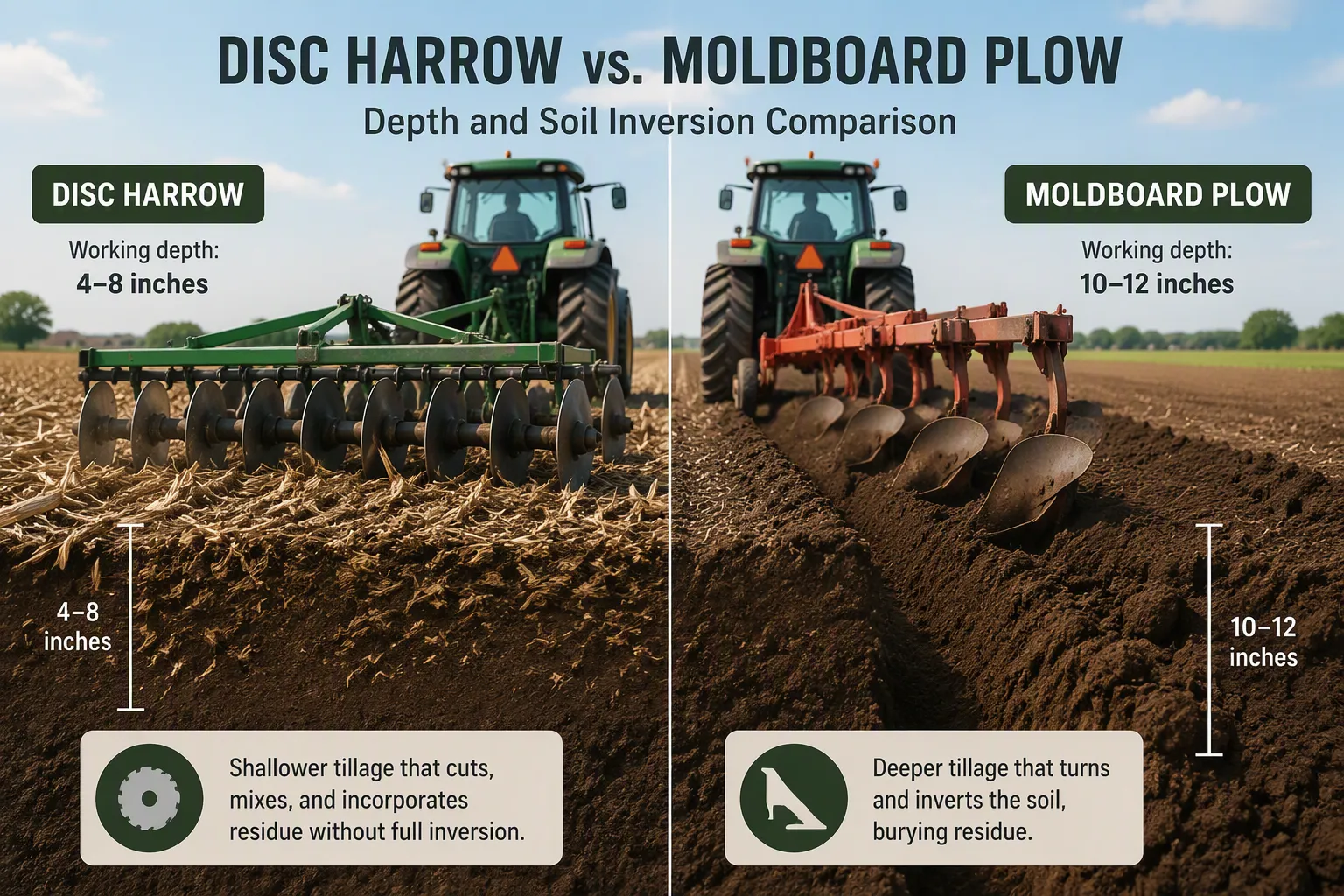
Every tillage choice means giving up something to gain something else. Each tool has strengths and weaknesses. Knowing these trade-offs helps you pick the right machine for your goals. Let's look at the good and bad points of each option side by side.
The disc harrow earns its spot on many farms because it handles several jobs at once. You get flexibility, fuel savings, and good seedbed quality from one machine. But you also face limits in depth and soil turnover.
Versatility stands as the disc harrow's greatest strength. You can use it for first tillage in tough ground or second tillage after plowing. You can change the disc angle to fit your field conditions. You can work in sandy loam or clay soils with the right blade choice. One machine handles many jobs across your farm.
Fuel efficiency surprises many farmers who compare numbers. A disc harrow does need more pull than a cultivator in loose soil. However, it often mixes residue in fewer passes. Fewer passes can offset its higher fuel use per pass. In hard or residue-heavy fields, you may burn less fuel overall because you cross the field fewer times.
Seedbed quality improves noticeably with disc harrow use. The curved blades break large clods into finer soil as they roll. Each pass creates a smoother, more even surface. This fine seedbed helps seeds sprout and supports steady crop growth. Seeds touch soil better, which means more even sprouting across your field.
Shallow working depth limits your options. A disc harrow usually cuts only 4 to 8 inches into the soil. This depth works fine for seedbed prep and mixing surface residue. But you cannot break up deep hardpan layers or reach packed subsoil. If your field has a plow pan below 8 inches, the disc harrow will not fix that issue.
Soil inversion stays minimal with disc harrows. The discs mix soil rather than flip it. Residue stays near the surface where it breaks down slowly. Weed seeds remain close to sprouting depth. Disease organisms in surface residue survive to harm your next crop. You keep organic matter, but you lose the cleaning effect of full turnover.
You may need more passes to reach your goal. One pass with a disc harrow often leaves the field rough. You might need two or three passes to make a proper seedbed. Each extra pass costs fuel, time, and labor. You also risk creating a smeared layer in wet clay soils, which hurts drainage and root growth.
The moldboard plow offers power and thoroughness that other tools cannot match. You get full soil turnover and deep cutting. But these benefits come with real costs in fuel, time, and soil health.
Deep inversion gives you complete residue burial. The moldboard plow turns soil almost fully upside down. It buries crop residue, weed seeds, and surface pathogens below the sprouting zone. You start each season with a clean, dark field ready for planting. This full turnover also spreads manure and soil additives evenly through the plow layer.
Weed control improves through deep burial. The plow pulls up established weeds and buries their seeds deep underground. Many weed species cannot come up from depths greater than 2 inches. Regular plowing lowers weed pressure over several seasons. You depend less on herbicides when you bury weed seeds well.
Hardpan breakup opens your soil profile. A moldboard plow cuts 6 to 14 inches deep, based on your settings. This depth lets you break compacted layers that block root growth and water flow. You bring fresh, nutrient-rich soil to the top. You also create drainage channels that help extra water escape from heavy fields.
High fuel use strains your operating budget. Moldboard plows need about double the pull of disc harrows for the same working width. You need a bigger tractor with more horsepower. You burn more diesel per acre, and you spend more hours in the field because plowing moves slowly.
Soil erosion risk rises sharply with plowing. The table below shows how different tillage methods affect your soil:
Plowing Method | Soil Disturbance | Erosion Risk | Water Retention |
|---|---|---|---|
Moldboard Plowing | High | High | Low |
Chisel Plowing | Moderate | Moderate | Moderate |
No-Till | Minimal | Minimal | High |
Moldboard plowing leaves bare soil open to wind and rain. Without residue cover, topsoil washes or blows away. You lose valuable organic matter and nutrients with each erosion event.
Moldboard plowing can cause subsoil compaction. This issue often happens when a wheel runs in the furrow. The weight of your tractor presses down on the furrow bottom. This compaction creates a "tillage pan" that needs more power and extra tillage passes to prepare a seedbed. This added effort leads to higher fuel use and emissions, creating a "vicious tillage spiral" that harms soil structure and raises the need for more tillage. You end up working harder each season just to keep the same results.
Speed limits slow your progress. A moldboard plow moves at about 4 to 6 miles per hour in good conditions. You cover fewer acres per hour than you would with faster tools. Wet or heavy soils slow you down more. When planting windows are short, this slower pace can cost you valuable time.
Your choice between these tools depends on which trade-offs you can accept. A disc harrow saves fuel and builds soil health but leaves residue on top. A moldboard plow gives you a clean start but risks erosion and compaction. Match the tool to your priorities, and you will make the right decision for your farm.
Your farm's tillage philosophy shapes which tool belongs in your shed. You must consider your crop rotation, soil health goals, and equipment budget. The right choice also depends on whether you follow conventional methods or embrace conservation practices. Let's walk through each system to see where these tools fit best.
Conventional tillage follows a clear sequence of operations. Each step prepares the soil for planting in a specific way.
Primary tillage: You perform moldboard plowing in the fall or spring to invert the soil and bury crop residue.
Secondary tillage: You follow the plowing with one or two passes using a disc harrow or field cultivator to break up clods and smooth the seedbed.
Planting: You plant the crop into the prepared seedbed.
Cultivation: You perform post-planting cultivation for weed control.
This sequence shows you the natural partnership between these tools. The moldboard plow handles the heavy first pass. The disc harrow then refines the rough soil left behind. You get a clean, level seedbed that warms quickly in spring. Many farmers prefer this system for heavy residue crops like corn or for fields with serious weed pressure. You trade some soil health for a predictable, clean start each season.
Conservation tillage flips the conventional approach on its head. You keep more residue on the surface to protect soil from erosion. You also promote aerobic decomposition, which builds organic matter over time.
According to agricultural experts, mulch tillage substitutes disc harrows for the moldboard plow in primary tillage. This practice leaves crop residue on the soil surface, reducing erosion and promoting aerobic decomposition, which benefits organic farming systems.
This substitution matters for your decision. A disc harrow lets you manage residue without burying it completely. You maintain ground cover that shields soil from wind and rain. The moldboard plow, by contrast, buries residue deep where it breaks down slowly. If you want to build soil health while still tilling, the disc harrow gives you that middle ground. No-till systems skip tillage entirely, so neither tool fits that approach. But for conservation tillage, the disc harrow offers the flexibility you need.
Your soil texture should guide your final choice. Different implements perform better in different ground conditions. The table below shows general recommendations from tillage research.
Soil Type | Recommended Implement |
|---|---|
Heavy clay | Chisels or rippers |
Dry loam | Sweeps |
Very light sandy soils | Tine cultivators, disc cultivators, shallow tillage combination cultivators |
Light soils | Minimum tillage |
Heavy clay soils respond best to tools that shatter rather than smear. Chisels or rippers break up dense layers without turning the soil over completely. A moldboard plow can work in clay, but you risk creating a slick furrow bottom. Sandy soils need gentler treatment. Tine cultivators and disc cultivators mix residue without disturbing the fragile structure. Loam soils give you the most flexibility. You can use sweeps or a disc harrow effectively in these balanced conditions.
Your specific field conditions may differ from these general guidelines. Test your soil to understand its texture and structure. Watch how water behaves after rain. These observations help you match the right tool to your land. The best choice balances your tillage goals with the natural characteristics of your soil.
DADI MACHINERY has spent over 17 years building reliable tillage tools for farmers around the world. The company designs and manufactures equipment in Shandong, China. Every machine meets ISO9001 quality standards. You get durable tools that match your farm's specific needs. The product range includes disc harrows, disc plows, subsoilers, and more. Each tool goes through strict quality checks before shipment.
The 1BZ Heavy-duty Disc Harrow handles tough primary tillage jobs. It clears plant stubble from your fields. It crushes large soil clods into smaller pieces. This model works well in heavy clay soil and uncultivated land. The heavy frame and strong discs dig deep into hard ground. You can use it for first tillage in spring or fall. The 1BZ saves you time by combining stubble cleaning and soil breaking in one pass. It prepares your field for the next step in seedbed preparation. The discs are made from high-carbon or boron steel for long life. You can adjust the working angle to match your soil conditions. This flexibility makes the 1BZ useful for different field types.
The Reversible Disc Plow offers a modern alternative to traditional moldboard plows. It turns over soil deeply at speeds of 8 to 10 kilometers per hour. This plow gives you deep soil inversion without the high draft of a moldboard. The discs cut through residue and mix it into the soil. You get a clean furrow that buries weeds and crop material. The reversible design lets you work back and forth across the field without empty return trips. This saves time and fuel. You cover more acres in less time. The plow works well for primary tillage and seedbed preparation. It handles both light and heavy soils effectively. You can adjust the disc angle for different working depths.
DADI MACHINERY stands out for its commitment to your success. The company adjusts equipment dimensions to fit your local crops. Whether you grow cassava, peanuts, or other crops, the machine works for your conditions. The result is stable ridges and higher seedling emergence rates. The parts resist wear and last longer. This reduces your operating costs and lowers the need to keep spare parts on hand. You also get free blueprints and promotional materials for your business. After-sales support ships parts quickly when you need them. The company serves clients in over 20 countries. Distributors and farmers trust the brand for its reliability.
Customer satisfaction reflects this approach. Over eight years of partnership, one distributor reported that farmer complaints virtually disappeared. Annual orders grew from 35 to 160 units. The distributor expanded partnerships to over 120 new cooperatives. Customer acquisition efficiency doubled thanks to ready-made marketing materials. These numbers show the real value of working with DADI MACHINERY.
"Dadi Machinery is the most attentive Chinese agricultural machinery manufacturer I have ever worked with. Over eight years of partnership, the equipment failure rate has been extremely low; farmers actively recommend my store for Dadi ridgers. They are a partner worthy of long-term trust."
Your choice depends on depth, soil type, leftover plants, money, and how you like to farm. Disc harrows work best for second tillage, getting seedbeds ready, and using less fuel. Moldboard plows are great at turning soil over deep and covering heavy leftover plants.
First, check your own field conditions. Test your soil. Look at what crops you grow each year. Think about trying a tool on a small area before you buy one.
Today, many farmers prefer less tillage. Still, both tools are useful in different cases. DADI MACHINERY offers good options for either way. Their 1BZ Heavy-duty Disc Harrow does first tillage well. Their Reversible Disc Plow turns soil deep without needing as much tractor power as a moldboard.
Visit www.dadidischarrow.com or reach out to DADI MACHINERY for help picking the right tool. Choose the one that fits your land and your farming goals.
A disc harrow typically cuts 4 to 8 inches into the soil. A moldboard plow reaches 6 to 14 inches deep. Choose the disc harrow for seedbed preparation. Pick the moldboard plow when you need to break up hardpan layers below 8 inches.
The moldboard plow handles heavy clay more effectively. Its sharp share cuts clean lines through dense ground, and the curved moldboard lifts soil without smearing. A disc harrow works best in sandy or loamy soils where its discs can penetrate easily.
Yes. Moldboard plows need about double the draft force of disc harrows for the same working width. You burn less diesel per acre with a disc harrow. You also cover ground faster, which reduces your total fuel costs across the season.
No. A disc harrow chops residue and mixes it through the top few inches, leaving 40 to 70 percent on the surface. A moldboard plow buries nearly all residue completely. Use the disc harrow when you want protective ground cover remaining.
Yes, for most weed types. The moldboard plow buries weed seeds deep below the germination zone. The disc harrow only chops weeds and leaves seeds near the surface where they can sprout. However, plowing can bring old buried seeds back up.
A moldboard plow needs 10 to 15 horsepower per bottom. A disc harrow needs only 5 to 6 horsepower per foot of working width. Smaller tractors can pull disc harrows effectively. Moldboard plows demand larger, heavier machines with more drawbar power.
Yes, many farmers do. Use the moldboard plow for primary tillage in fall or spring to invert soil and bury residue. Follow with a disc harrow for secondary tillage to break clods and smooth the seedbed before planting.
Disc harrows have fewer wear parts, and you can replace individual blades as needed. Moldboard plows need regular replacement of shares and moldboards, especially in rocky ground. However, plow frames last for decades, spreading the initial cost over many seasons.


