

close
Choose Your Site
Global
Social Media
Views: 0 Author: Site Editor Publish Time: 2026-09-02 Origin: Site


A disc harrow is a strong farming tool. It uses round, curved metal blades to cut, lift, and flip soil. You pull it behind a tractor, and the blades spin as you move. Each blade is angled and heavy enough to dig into the ground well. This action breaks up dirt clumps and mixes leftover crop pieces into the soil.
This tool fixes a common issue for you. Breaking hard soil by hand or with old ways takes a lot of time and work. A disc harrow makes basic soil prep much faster. It creates a smooth seedbed in just one pass. Knowing how it works helps you see why disc harrows are key farm tools. Later, you will learn about the different types and how they help with soil prep. This info helps you choose the right one.
A disc harrow uses spinning, curved blades to break up soil, manage weeds, and mix leftover crop material in a single pass.
Choose a tandem disc harrow for final work on soil that has already been tilled. Choose an offset model for tough first tilling.
Set a steeper gang angle to cut deeper into the soil; use a shallower angle for lighter, finishing passes.
Match the disc harrow size to your tractor's horsepower so you don't strain the engine or waste power.
Taking care of your disc harrow regularly, like greasing the bearings and sharpening the blades, helps it last longer.
Using a disc harrow improves soil structure, boosts water absorption, and cuts down on organic matter loss when compared to moldboard plowing.
Hydraulic adjustments let you change the blade angle while you work, saving time in different field conditions.
Proper storage, like cleaning and oiling the blades, stops rust and keeps your disc harrow ready for the next season.
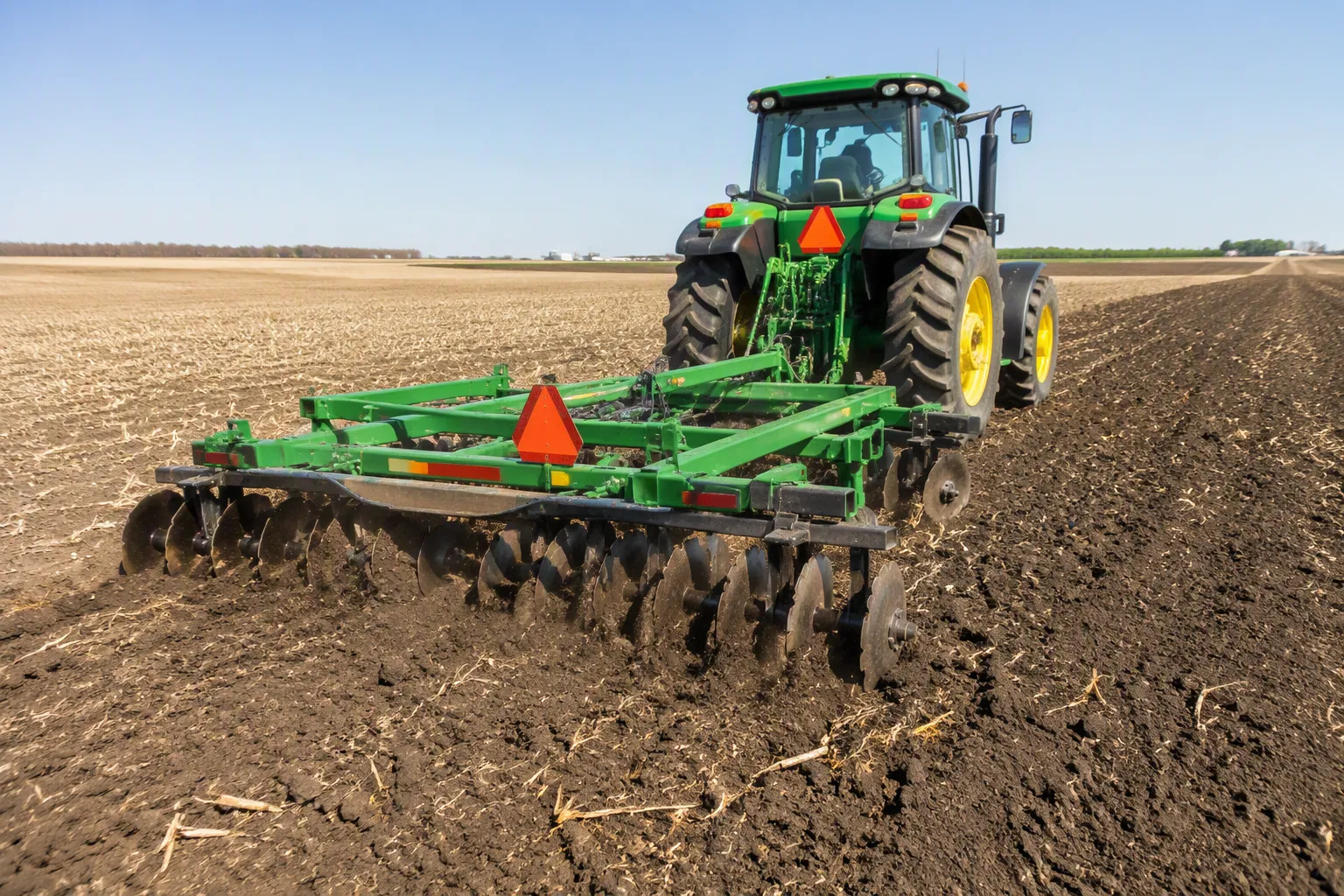
A disc harrow performs several essential jobs in one pass. It breaks up compacted ground, slices through weeds, and mixes leftover crop material into the earth. You pull it behind a tractor, and the spinning blades do the heavy work. This tool turns rough, uneven fields into a smooth, ready-to-plant surface. Understanding its core functions helps you see why it matters for your farm.
Function | What It Does for You |
|---|---|
Breaking and loosening soil | Penetrates deep to break clods and compact layers, improving aeration and root growth. |
Weed control | Cuts and buries weeds, reducing competition and the need for chemical herbicides. |
Mixing crop residue | Incorporates post-harvest residues into the soil, enhancing fertility through decomposition. |
Improving moisture retention | Creates a finely tilled surface that reduces evaporation and retains soil moisture. |
Saving time and labor | Compared to manual methods, a tractor-mounted disc harrow speeds up large-field preparation. |
Each function works together. When you break up hard ground, roots grow deeper. When you bury weeds, crops face less competition. When you mix residue, nutrients return to the earth. The result is a healthier field with less effort from you.
You need to know the main components before you use this tool. Every disc harrow relies on four core parts working as a system.
The concave discs are the round, bowl-shaped blades that do the cutting. They curve inward like a shallow bowl. This shape lets each blade lift and turn soil as it spins. Manufacturers make these discs from carbon steel for standard use. For longer life, you can choose boron steel, which resists wear better. Heavy-duty discs for primary tillage come in diameters of 26, 28, 30, 32, 36, and 40 inches. Lighter secondary discs measure 20, 22, 24, or 26 inches across. The spacing between discs on heavy-duty units ranges from 10 to 14 inches, with some models set at 18 inches apart.
The bearings sit at the center of each disc or gang. They let the blades spin freely while you pull the harrow forward. Quality bearings reduce friction and prevent overheating during long workdays. You should check them regularly for wear.
The frame holds everything together. It supports the weight of the discs and transfers pulling force from your tractor. A sturdy frame keeps the implement stable, even on rough terrain. Most frames use heavy steel beams that resist bending under load.
The scrapers clean the discs as they rotate. Wet, sticky soil can cling to the concave surface. Scrapers remove this buildup so each blade keeps cutting effectively. Without them, you would stop frequently to clear mud by hand.
Disc thickness matters too. For 18-inch concave discs, you can choose 3mm, 3.5mm, or 4mm steel. For 20-inch discs, options range from 3.5mm up to 6.35mm. Thicker discs weigh more and last longer, but they also require more tractor power to pull.
You might wonder how disc harrows compare to other tillage tools. Two common alternatives are spring harrows and moldboard plows. Each serves a different purpose.
Spring harrows use flexible tines that vibrate as you pull them. They work well for light surface leveling and removing small weeds. However, they cannot penetrate hard, compacted ground. Their tines simply bounce over tough soil instead of cutting into it. Disc harrows dig deeper and break up clods more effectively.
Moldboard plows take a different approach. They use a large curved blade to completely invert a strip of soil. This action buries all surface residue deep underground. Moldboard plows work at greater depths, often 8 to 12 inches. They suit primary tillage on land that has not been farmed for years.
Disc harrows sit between these two tools. They work at shallower depths than moldboard plows, usually 3 to 6 inches. Yet they provide better pulverization than spring harrows. The concave discs chop and crumble soil into fine particles. This creates a smoother seedbed than a spring harrow can achieve. For most farmers, disc harrows offer the best balance of depth and soil conditioning.
You need to understand where a disc harrow fits in your tillage sequence. Tillage happens in two stages: primary and secondary.
Primary tillage is the first pass after harvest. It breaks up the top layer of soil, buries heavy residue, and prepares the ground for further work. Heavy-duty disc harrows excel at this job. Their large, widely spaced discs cut through tough plant stubble and hard clay. You use them on fields that have not been worked recently or that contain heavy crop residue.
Secondary tillage comes after primary tillage. This stage refines the soil further. It breaks down remaining clods, levels the surface, and creates a fine, consistent seedbed. Lighter disc harrows with smaller discs handle this task well. They smooth out the rough surface left by primary tools.
Many farmers use disc harrows for both stages. You might run a heavy offset model first to break new ground. Then you switch to a lighter tandem unit for final preparation. This two-pass approach gives you excellent seedbed quality without excessive tractor wear.
The quality of tillage depends on matching the right tool to each stage. Using a heavy disc harrow for secondary work can over-pulverize the soil. Using a light model for primary tillage leaves the ground too rough. Choose your equipment based on the condition of your field and the results you want.
A disc harrow proves versatile enough for most soil preparation needs. Whether you prepare new ground or refine an existing seedbed, this tool delivers consistent results. Understanding its parts and how it compares to other harrows helps you use it correctly. You will get better performance and longer equipment life when you match the tool to the task.
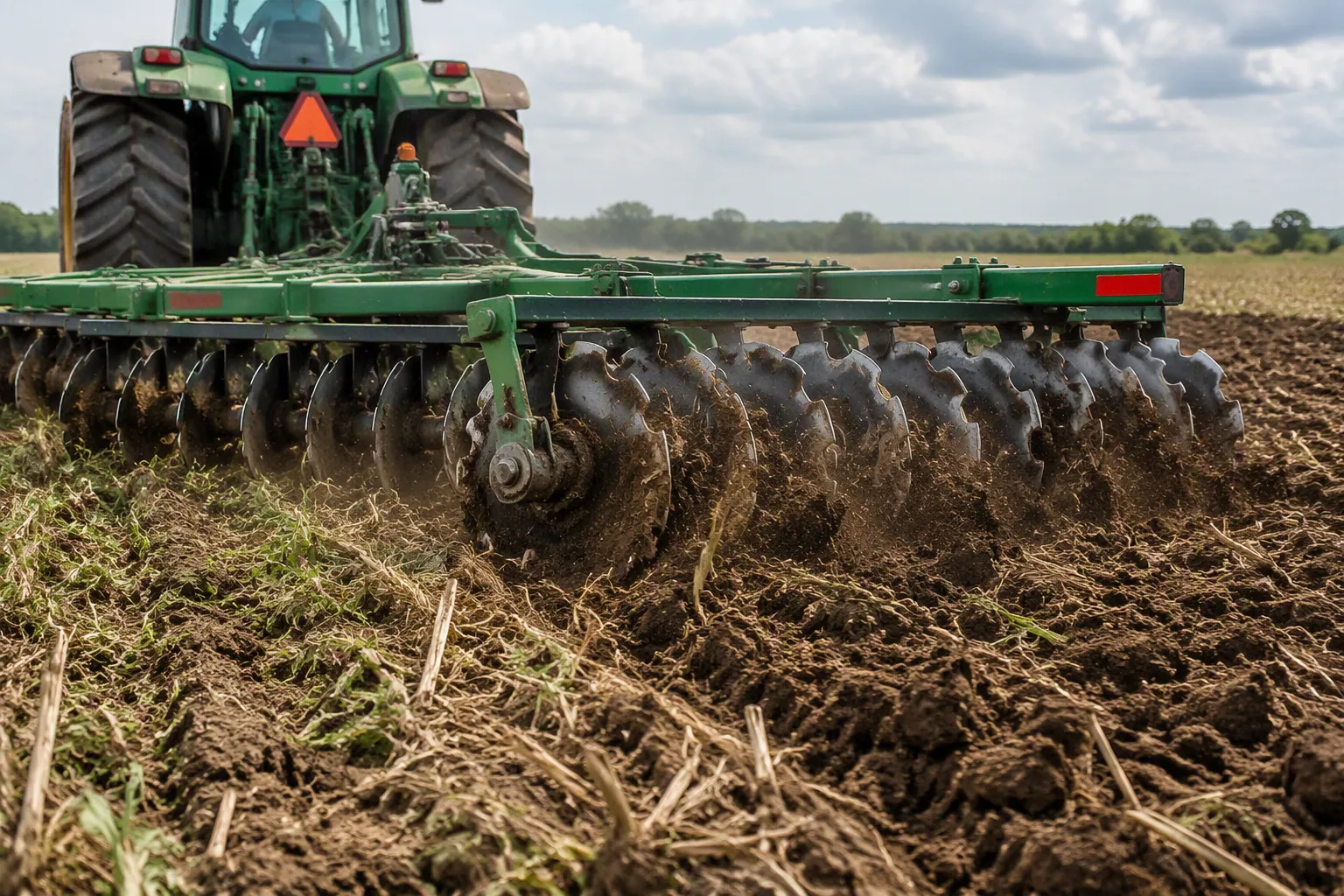
The disc harrow works by spinning blades and setting them at the right angle. You pull it behind your tractor, and the spinning parts do the job. Knowing this helps you set up your equipment the right way for each field.
The process starts with the curved discs. Each disc is round and shaped like a shallow bowl. As your tractor moves forward, the discs spin on their own. The sharp edge of each disc cuts into the ground. This cuts through weeds and old crop pieces without getting stuck.
The spinning discs go into the soil. They pick up small amounts of dirt and flip it over. Weeds get cut at the roots, pulled up, and buried under the soil. This stops them from growing back. The spinning parts also chop up leftover plants from the last harvest. These pieces mix into the dirt and break down over time. This adds nutrients that make the soil better for growing.
The bowl shape creates a rolling motion that lifts and breaks up dirt clumps. This loosens the soil without needing another tool. As the spinning parts move, the field becomes level and ready for planting. You get a smooth surface in one pass.
How fast the discs spin depends on how fast you drive. Going faster makes the discs spin quicker, which cuts more. Going slower gives the dirt more time to break apart and mix. You can change your tractor speed to fit the field. Each disc spins based on how fast you move forward. The bowl shape pulls dirt up and to the side. This creates a turning action that mixes the top layer well. The discs work together across the whole width of the tool. This gives even soil mixing across the full working area.
How deep you till depends on two things: the weight of the harrow and the angle of the spinning parts. Both work together to control how deep it goes.
The disc angle matters a lot. A steeper angle makes the discs dig deeper. When you set the angle steeper, the spinning parts bite into the ground harder. They pull up more dirt and make deeper grooves. But a steeper angle also raises the risk of erosion on hills.
A shallower angle makes the discs go less deep and work less hard. The spinning parts skim across the top instead of digging down. This works well for finishing jobs where you want a light touch. You can use a shallow angle after the first tillage to smooth the seedbed.
You can also adjust the three-point hitch angle. Setting the hitch steeper lowers the harrow deeper into the ground. This makes it work deeper. A shallower hitch angle raises the tool, so it works less deep. This change affects how hard the spinning parts work by changing how much they touch the ground.
Weight matters too. Heavier disc harrows push the blades deeper without needing a steeper angle. You can add weight to some models. This helps in hard, dry dirt where it is hard to dig in. The mix of weight and angle gives you good control over the results. The weight of your tool affects how well it works in different soils. Lighter models work well in loose, sandy dirt. Heavier models handle clay and packed ground better.
Gangs are groups of spinning parts mounted on one axle. Each gang can be set at a different angle. The front gang usually has a steeper angle than the rear gang. The front cutting gang breaks up the ground first. The rear smoothing gang follows to make the surface even.
Setting gangs straight makes them go less deep. The spinning parts just roll along without digging in. This does not work well for the job. Setting gangs to a steeper angle makes them work harder. You want the front gang at a steeper angle to get the depth and soil mixing you need. The rear gang works at a shallower angle to smooth and level the ground.
Overlap is another key factor. When you make passes across the field, each pass should overlap the last one a little. This stops ridges and makes sure you cover everything. How much overlap you need depends on your spacing and gang angle. Wider spacing needs more overlap. Narrower spacing needs less.
You can check your overlap by looking at the ground behind you. If you see ridges between passes, increase your overlap. If the surface looks flat and even, your overlap is right. Good overlap saves time by cutting down the number of passes you need. The right overlap setting depends on your field. In soft ground, less overlap works well. In hard, packed ground, more overlap makes sure you cover everything.
The mix of gang angle and overlap gives you control over the final seedbed quality. You can adjust both to fit your field type and what you want to grow. This flexibility makes disc harrows useful for many different farming jobs.
Picking the right tool starts with knowing the main styles. You will see two basic designs for sale: tandem and offset. Each one does a different job in your field. Knowing the difference helps you pick the right tool for your work. Both types share the same basic parts, but their frame setups change how they work.
A tandem disc harrow has two sets of discs placed one behind the other. The front set throws soil one way, and the back set throws it the other way. This back-and-forth action levels the ground as you move. The result is a smooth, flat surface that works well for finishing jobs.
You should pick a tandem model when you work on ground that is already tilled. This type of disc harrow is best for secondary tillage. It breaks up leftover clumps and makes a fine seedbed for planting. The lighter frame needs less power from your tractor. You can make several passes without wearing out your equipment.
Tandem units also give you a smoother finish on the surface. The opposite disc angles cancel out the ridging effect. You get a flat field ready for seeding. This design works best on level fields without heavy plant leftovers. If you face thick plant stubble or tough sod, a tandem unit may have trouble cutting through.
An offset disc harrow sets its gangs so the soil moves one way only. The rear gang sits fully behind the front gang, not next to it. This makes a stronger cutting action. The offset design pulls harder into the ground and handles tougher conditions.
You need an offset model for primary tillage jobs. It cuts through new land, heavy plants, and thick crop leftovers. The sharp angle lets the blades dig deep into hard soil. This type of disc harrow can also work closer to fences and buildings. The offset frame lets you move near obstacles without leaving missed strips.
Aspect | Tandem | Offset |
|---|---|---|
Aggressiveness | Less aggressive | More aggressive |
Primary use | Finishing work on already tilled soil | Primary tillage, new land, heavy plants |
Surface finish | Can be set for a smoother finish | Leaves rougher surface |
Power requirement | Needs less horsepower | Needs more horsepower |
Obstacle proximity | Not specified | Can get closer to fences, buildings |
Tandem disc harrows are made for secondary tillage. When primary tillage is needed, the suggested disc-type tool is an offset disc harrow (or a disc plow), not a tandem disc harrow.
The offset design leaves a rougher surface behind. You may need a second pass with a lighter tool to smooth things out. But for breaking new ground, nothing works faster than an offset unit.
DADI MACHINERY offers dependable choices for both styles. The company has spent over 17 years building farm equipment. Their machines serve clients in more than 20 countries worldwide. Every unit meets ISO9001:2000 quality management standards.
The 1BZ Heavy-duty Disc Harrow handles primary tillage in unworked fields. It cleans plant stubble and crushes hard clumps well. This model suits heavy clay soil conditions. The 1BZDZ Heavy-duty Disc Harrow features a special single-beam design. It works well on wasteland, sticky soil, and large-area stubble tillage.
DADI MACHINERY also makes several other heavy-duty models:
Offset hydraulic heavy duty disc harrow
1BZN Series Hydraulic Heavy Rake
IBZ series hydraulic heavy harrow
1BZDZ folding hydraulic heavy duty disc harrow
V-shaped large notch 1BZ-6.2 offset heavy-duty disc harrow
1BZ Series Half Suspension Offset Hydraulic Heavy Duty Disc Harrow
These machines come with 24-hour after-sales service. The factory employs over 100 workers and makes more than 500 tons monthly. You can trust their experience when you pick your next harrow.
Knowing these types of disc harrows helps you make a smart choice. Match the style to your field conditions. You will save time and get better results from your tillage work.
You might wonder why so many farmers choose a disc harrow for their soil preparation work. The answer lies in what this tool does for your field. It saves time, improves soil health, and gives your crops a stronger start. Each pass with the harrow brings multiple benefits that compound over the growing season.
A good seedbed needs fine, loose soil with a smooth surface. Disc harrows deliver exactly that through two actions working together. The smooth discs have continuous cutting edges that slice through the ground. Each blade pulverizes clods into smaller pieces. This creates a fine, uniform texture that holds seeds at the right depth.
Tandem disc harrows add a leveling effect you cannot get from other tools. The front gangs throw soil outward. The rear gangs pull it back inward. These opposing forces balance each other naturally. The result is a field where ridges smooth out, valleys fill in, and wheel tracks disappear. You get consistent seed depth across the entire field. Seeds make good contact with the soil, which leads to uniform germination. The firm base with a loose cover gives young roots the ideal environment to establish.
The benefits of disc harrows extend far beyond surface appearance. When you drag the harrow across compacted ground, you mechanically disturb that hard layer. This reduces compaction and opens air pores throughout the soil profile. Better aeration lets plant roots grow deeper and reach nutrients and moisture they could not access before.
Improved gas exchange between the soil and atmosphere also benefits the microbes living there. These tiny organisms play a vital role in nutrient cycling. When they thrive, they break down organic matter faster and release nutrients your crops need. The harrow mixes organic material into the soil, improving its texture and structure. Research shows that incorporating crop residues through disc harrowing can increase soil porosity by 30 percent. Infiltration rates improve by 20.6 percent. Bulk density decreases by 6 percent. These changes mean water moves through the soil more easily, and roots face less resistance as they grow.
Weeds compete with your crops for water, nutrients, and sunlight. A disc harrow gives you a mechanical advantage against them. The spinning discs chop weeds at the root level. They pull the plants up and bury them beneath the surface. This stops weeds from regrowing and reduces the need for chemical herbicides.
The same action manages crop residues from your previous harvest. Leftover stalks and leaves get cut into smaller pieces and mixed into the top layer of soil. This speeds up decomposition because the residue comes into direct contact with soil microbes. The organic matter breaks down faster, returning nutrients to the ground for your next crop. Disc harrowing loses only 1,840 kg per hectare of organic matter over 19 days. Compare that to 4,300 kg lost with a moldboard plow combined with double disc harrowing. Your soil keeps more of its valuable organic content when you use a disc harrow for this job.
Each pass you make with the harrow prepares your field while improving the soil itself. You get a clean, level seedbed ready for planting. Your soil gains better structure and more available nutrients. Your crops face less competition from weeds. These combined benefits make the disc harrow an essential part of modern soil preparation.
Picking the right disc harrow for your farm takes careful thought. You need to match the tool to your tractor's power, your field's soil, and your budget. A good choice saves you money and stress. A bad choice leads to poor soil work and wasted fuel. This section helps you make the key decisions.
Your tractor's horsepower decides the size of disc harrow you can pull well. A harrow that is too big strains your engine and drivetrain. A harrow that is too small wastes your tractor's power. You need a good balance for efficient work.
The table below shows a common setup for a mid-sized tractor:
Model | Working Width | Disc Blade Diameter | Number of Blades | Recommended Tractor Power |
|---|---|---|---|---|
DH300-96C | 96 inches (8 feet) | 18 inches | 28 | 45–50 HP |
Based on advice from experienced tractor owners, a 50 HP tractor that weighs about 4,300 lbs can pull a tandem disc harrow with 22-inch blades that spans seven to eight feet wide. The cutting width is less than the total width. This size of disc is heavy enough to cut through sod in moist soil without plowing first. Keep in mind that your tractor's weight also matters. Heavier tractors grip the ground better and pull larger tools safely.
Your soil type plays a big role in choosing the right setup. Different ground conditions need different blade angles and harrow weights. You must check your fields before you buy.
Steep blade angles work well on clay soil. Flatter angles fit sandy soil better.
For clay or hard-packed loam, pick heavier harrow models. A 'Power Plow' style unit at 6 feet wide and 150 lbs handles tough ground well.
For sandy or loamy soil, lighter models work fine. An 'Easy-Glider' style unit at 4 feet wide and 100 lbs moves through loose ground easily.
Loamy soil usually needs a less aggressive setup. You can use a lighter harrow and still get good results.
You should also think about your field's history. New ground with thick sod needs a heavier harrow with sharper blades. Fields that were tilled in past seasons need less aggressive tools. Match your harrow to the hardest condition you expect to face.
Modern disc harrows give you two ways to change blade angle and depth. Manual adjustments mean you stop the tractor and change things by hand. Hydraulic adjustments let you change settings from the tractor seat.
Manual systems cost less at first. They work well for smaller farms where you rarely change settings. You stop, loosen bolts, adjust the angle, and tighten everything again. This takes several minutes each time.
Hydraulic systems add ease and speed. You pull a lever inside the cab to change the disc angle while moving. This feature helps when you work different fields in one day. You can adjust depth for different soil types without stopping. The extra cost pays for itself in saved time on larger farms.
Think about how often you will change settings. If you work similar fields, manual adjustment works fine. If you face different conditions daily, invest in hydraulic controls. Your choice affects both your comfort and your output.
For custom advice, visit DADI MACHINERY at https://www.dadidischarrow.com/ or call +86-13953408459. Their team helps you match the right harrow to your tractor and fields.
Your disc harrow works hard through every season. It slices through tough ground, spins at high speeds, and grinds against abrasive soil particles. Without regular care, small problems grow into expensive repairs. A simple maintenance routine keeps your equipment running smoothly for years. You protect your investment and avoid downtime during critical planting windows.
Check your harrow before every use. Walk around the implement and look for visible damage. Inspect each disc for cracks, dull edges, or warping. Replace damaged blades right away. A cracked disc can shatter during operation and cause serious injury. Dull edges reduce soil penetration and force your tractor to work harder.
Lubrication keeps the moving parts alive. Bearings and bushings need fresh grease according to the manufacturer's schedule. Follow this simple process for each bearing:
Clean the area around the bearing to remove dirt and old grease.
Locate all grease fittings on the bearing housing.
Prepare your grease gun with the correct lubricant and check for clogs.
Pump grease into each fitting until fresh grease emerges from the seals.
Rotate the disc components while greasing to spread the lubricant evenly.
Wipe off excess grease so dirt does not stick to it.
Repeat the process for every bearing on the harrow.
Write down the lubrication date and grease type for your records.
Tighten any loose fasteners you find. Vibration from fieldwork loosens nuts and bolts over time. Check the hitch and frame for bending, cracks, or rust before you start the engine. A weak frame can fail under load and damage your tractor.
Disc blades dull with use. A sharp blade cuts cleanly through residue and breaks up clods. A dull blade pushes soil aside instead of slicing through it. You can sharpen small nicks with an angle grinder. For badly worn blades, replacement costs less than the fuel wasted by poor cutting.
When you replace a blade, inspect the bearings at the same time. Remove both bolts on each disk gang hanger. Separate each bearing half to clean rust and dirt from the white iron parts. Soak stubborn parts with penetrating oil to loosen them. A 50/50 mix of acetone and automatic transmission fluid works well for rusted components. After cleaning, reassemble the bearing halves and apply fresh grease through the fitting. Tighten the end shaft nut very tight. Use a cheater pipe on your wrench if needed. Disk shafts are designed to run with the end nut fully tightened.
Adjust your gang angles based on field conditions. Steep angles work better for breaking new ground. Shallow angles suit finishing passes on prepared seedbeds. Match the angle to the job at hand for the best results.
Proper storage extends the life of your harrow. Clean the discs and frame thoroughly after each use. Wet soil and plant residue cause rust when left on metal surfaces. A pressure washer removes caked-on dirt quickly. Let everything dry completely before you store the implement.
Apply a light coat of oil to the disc blades before long-term storage. This protective layer keeps moisture away from the steel surface. Grease all fittings one final time before parking the harrow. Store the implement in a dry shed or under a tarp. Keep it off the ground on blocks if possible. This prevents moisture from wicking up from the floor and protects the blades from dulling against concrete.
Check the harrow again when you bring it out for the new season. Look for rust that may have formed despite your efforts. Touch up any bare metal spots with paint. Replace worn parts before you head to the field. A few hours of maintenance now saves you days of frustration later.
A disc harrow stands as a versatile, essential tool for your farming operation. It breaks up hard soil, prepares smooth seedbeds, and manages crop residue effectively. Understanding how disc harrows work helps you make a smart purchase decision.
Evaluate your current tillage setup honestly. Consider whether your fields need faster preparation and better results. Adding a disc harrow improves efficiency and boosts crop yields through improved soil structure and weed control.
For premium options, explore DADI MACHINERY's product line. Their heavy-duty models handle tough conditions with reliability. Visit their website or contact their team for tailored recommendations that match your tractor and field needs.
First, check your tractor's horsepower rating. A 50 HP tractor can usually pull a tandem disc harrow. This harrow has 22-inch blades and is seven to eight feet wide. Match the harrow's width to your tractor's power. Too big a harrow strains your engine. Too small a harrow wastes fuel and time.
Set your depth based on your goal. Primary tillage needs deeper work, usually 3 to 6 inches. Secondary tillage needs a shallower pass. Use the gang angle to control depth. A steeper angle digs deeper. A shallower angle skims the surface to finish the job.
Grease the bearings before each heavy use day. Also follow the manufacturer's schedule. First clean around each fitting. Pump fresh grease until it comes out of the seals. Rotate the parts while greasing. This spreads the lubricant evenly and prevents early wear.
Yes, you can use one harrow for both jobs. Pick a heavy-duty model with adjustable gang angles. Set a steeper angle to break new ground. Switch to a shallower angle for finishing passes. Many farmers use one versatile harrow all season.
Tandem models have front and rear gangs that throw soil in opposite ways. They level ground well for finishing work. Offset models throw soil in one direction only. They cut deeper and handle heavy leftovers better. Pick tandem for prepared fields. Pick offset for tough first tillage.
A good disc harrow lasts 15 to 20 years with proper care. Regular grease and blade changes help it last longer. Store it under cover when not in use. Put oil on the blades before long storage. Rust and moisture cause the most damage over time.
Scrapers are needed for most conditions. Wet, sticky soil sticks to concave discs and makes them cut less well. Scrapers remove this buildup as the harrow works. Without them, you must stop often to clear mud by hand. This wastes time and slows your work.
Use an angle grinder for small nicks and light dulling. Take off badly worn blades and replace them. Sharp blades cut through leftovers and break up soil well. Dull blades push soil aside and waste tractor power. Check blade edges before each season.


